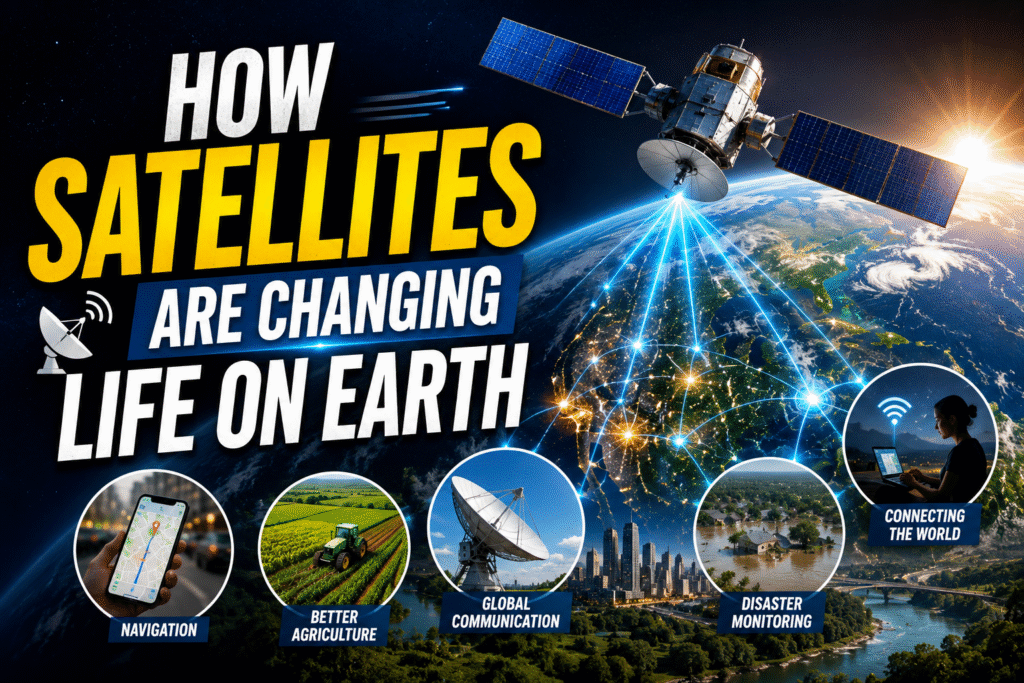

If someone asked people in the 1980s what satellites would be used for in the future, most answers probably would’ve sounded dramatic. Space missions. Secret government projects. Maybe astronauts floating around somewhere above Earth.
Very few people would’ve guessed that one day satellites would help ordinary people order food, avoid traffic jams, watch YouTube videos, or find the nearest coffee shop.
That’s the funny part about technology. The biggest changes usually become so normal that people stop noticing them.
Today, satellites are involved in daily life almost constantly, even when nobody thinks about them. They’ve quietly moved from being “space technology” to just another part of how the modern world works.
And honestly, if they suddenly disappeared, people would realize very quickly how dependent we’ve become.
Nobody Really Thinks About GPS Until It Stops Working
A few years ago, I remember seeing someone trying to drive through a crowded city after losing internet and GPS access on their phone. Within minutes they looked completely stressed out.
Missed turns. Wrong roads. Constant confusion.
It was kind of funny at first, but it also showed how much navigation has changed.
Before smartphones, getting lost was completely normal. People carried paper maps in cars. Travelers wrote directions on small pieces of paper before leaving home. If you were in another city, there was a decent chance you’d stop and ask strangers for help.
Now people expect perfect directions instantly.
That convenience exists because of satellites orbiting above Earth. Your phone constantly connects with satellite systems to calculate location and movement in real time.
What feels ordinary today would’ve sounded unbelievable decades ago.
And it’s not just regular drivers using this technology.
Planes crossing oceans rely heavily on satellite navigation. Shipping companies use it for cargo routes. Delivery apps track drivers every second. Farmers even use satellite-guided machinery while planting crops.
Space technology somehow became everyday technology without most people realizing when the transition happened.
Weather Forecasts Used to Be Much Less Accurate
People love complaining about weather apps.
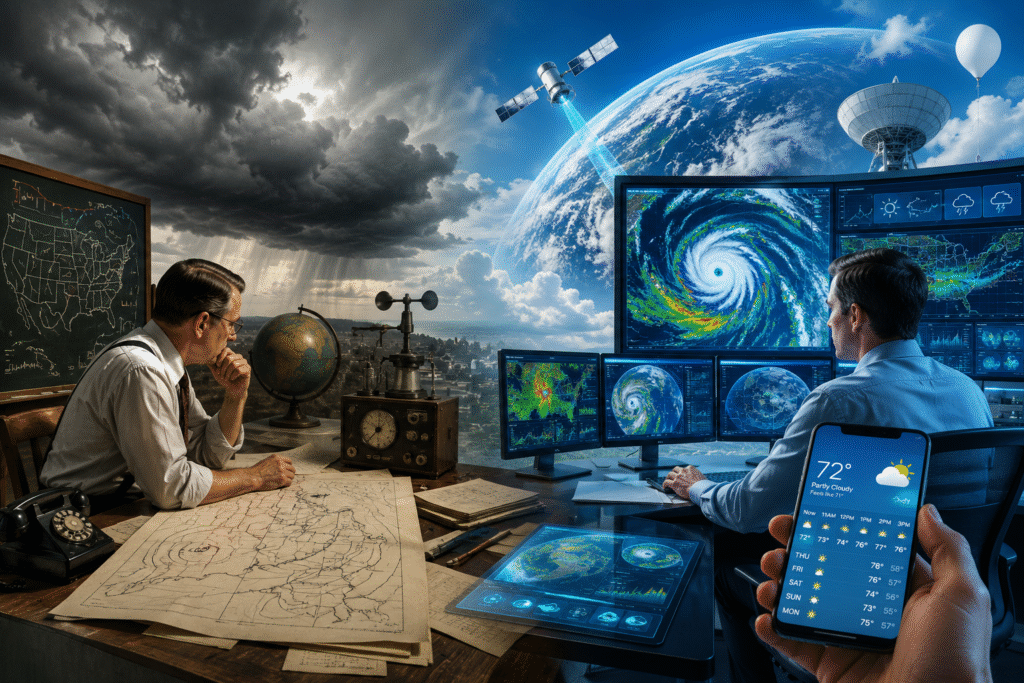
The funny thing is, weather forecasting today is actually incredibly advanced compared to the past.
Years ago storms were more difficult to track accurately. Hurricanes could strengthen before officials fully knew what was going on.
Today satellites constantly watch cloud movement, ocean temperatures, atmospheric pressure and storm formation.
Meteorologists can follow weather systems as they form, even when they’re far from land. Governments could issue earlier warnings. Airlines can adjust routes before severe weather becomes dangerous.
That extra preparation time matters more than most people think.
A few additional hours before a cyclone or flood can literally save lives.
Even simple daily forecasts became more reliable because satellites constantly collect updated information from around the planet.
Most people open weather apps without thinking twice, but there’s an enormous amount of technology working behind those small temperature icons.
Communication Changed More Than People Realize
There was a time when calling another country felt expensive and complicated.
Younger generations sometimes don’t realize this because they grew up with the internet already everywhere.
International communication used to feel slower and less connected. Live broadcasts were limited. Remote regions often had weak communication systems.
Satellites helped change all of that.
Today someone in a small village can video call relatives living overseas almost instantly. News spreads globally within seconds.
When earthquakes, floods, or hurricanes damage communication towers on the ground, satellite systems often help rescue teams stay connected.
It’s one of those technologies people barely notice until something goes wrong. Even satellites are helping in making green technologies, better.
Farmers Started Using Space Technology Too
This still surprises some people.
When most individuals hear the word “satellite,” farming usually isn’t the first thing that comes to mind. But agriculture has become surprisingly technical over the years.
Farmers now use satellite data to monitor crops, soil moisture, water levels, and temperature changes across large areas of land.
Instead of checking everything manually they can identify problem areas much faster.
If one section of a field lacks water or shows signs of disease, satellite imaging can sometimes detect the issue before it spreads further.
That saves time, water, and money.
And considering how unpredictable weather patterns have become in many regions, access to better agricultural data matters a lot.
Food production today depends more on technology than many people realize.
Satellites Help Scientists Understand Earth Better
One major advantage of satellites is simple: perspective.
Humans on the ground can only observe so much at once. Satellites can observe huge portions of Earth continuously.
This allows scientists to follow environmental changes over long periods of time much more clearly.
They track deforestation, shrinking glaciers, wildfire spread, rising sea levels, pollution, drought conditions, and changing ocean temperatures.
Without satellites, a lot of environmental research would be a lot slower.
For example, satellites can detect illegal logging deep in forests where humans cannot monitor. They can track the flow of smoke during wildfires or track how fast ice is melting near the polar regions.
Whether you’re a climate science junkie or not, satellites provide a lot of information that researchers use all over the world.
Bringing Internet Access To Remote Areas
All the major cities seem to have perfectly fast internet, but in many rural areas the connections are still weak.
Building out traditional internet infrastructure everywhere is expensive. Mountains, deserts, forests, and isolated communities are difficult places to connect using cables alone.
Satellite internet is helping solve part of that problem.
Some newer satellite systems aim to provide internet coverage almost globally, including places where reliable access barely existed before.
That can create real opportunities.
Online learning is extended to students in remote villages. Business is easier to communicate with international customers. Doctors can provide remote consultations when hospitals are constrained.
For some communities, internet access changes education and work opportunities completely.
Disaster Response Became Faster
Natural disasters create chaos quickly.
Roads become blocked. Electricity fails. Communication systems collapse. Neighborhoods can be cut off from each other.
Satellites can provide emergency teams with a much faster view of what is happening from above.
After earthquakes, rescue organizations can examine damage through updated satellite imagery. During floods they monitor the flow of water and identify the worst affected areas. Wildfires can also be monitored from space in real-time.
It means governments and emergency teams can respond more efficiently.
When every minute matters, accurate information becomes extremely important.
Space Is Getting Crowded
Of course, not every satellite-related development is positive.
There’s now a growing problem involving space debris.
Thousands of inactive satellites and broken fragments orbit Earth at extremely high speeds. Even small pieces of debris can damage active satellites during collisions.
Scientists are becoming increasingly concerned about overcrowded orbital zones.
If too much debris accumulates, future launches and satellite operations could become more dangerous.
It’s strange in a way. Humanity managed to create traffic problems even in space.
Private Companies Are Changing the Industry
For decades, space technology was mostly associated with governments and national space agencies.
That’s changing fast now.
Private companies are putting satellites into orbit for communications, internet services, mapping and research projects. Smaller satellites have never been more affordable and accessible.
This competition is accelerating innovation quickly.
Space technology no longer feels limited to science fiction movies or government missions. It’s becoming part of business, communication, transportation, and global infrastructure.
Final Thoughts
Satellites changed life on Earth quietly. There wasn’t one single moment where everything suddenly transformed overnight.Instead, satellites gradually hooked up to communications, navigation, farming, weather forecasting, disaster response, internet access and scientific research.