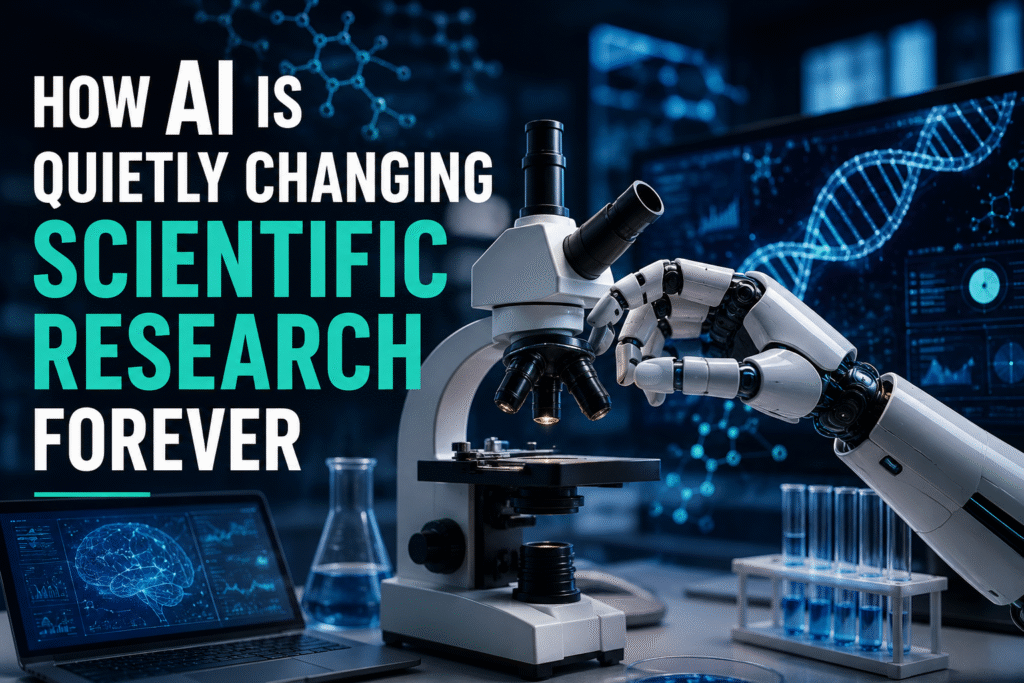

Most people think of Artificial Intelligence as something connected to chatbots, robots, or social media algorithms. That’s usually where the conversation stops. But honestly, one of the biggest changes AI is causing right now is happening in scientific research, and a lot of people don’t even realize it.
Researchers across the world are already depending on AI every single day. Hospitals use it. Climate scientists use it. Space agencies use it. Pharmaceutical companies use it. Even university laboratories with smaller budgets have started integrating AI tools into their work because modern research has become incredibly data heavy.
That’s really the main reason AI became so important in science.
The amount of information researchers deal with today is honestly overwhelming. Every experiment, medical scan, satellite image, climate report, and genetic test produces more and more data. Twenty or thirty years ago, scientists could manually process a large portion of their research. Today, that’s almost impossible in many fields.
AI stepped in because humans simply cannot analyze everything quickly enough anymore.
And no, that doesn’t mean scientists are becoming irrelevant.
That’s one thing people misunderstand constantly whenever AI is discussed. Researchers still make the important decisions. They still question theories, design experiments, and interpret results.
In a way, AI is becoming more like a research assistant than a replacement for human intelligence.
Scientific Research Has Become Too Complex for Traditional Methods
Modern science moves fast. Much faster than it used to.
A single research project today can generate millions of pieces of information. In healthcare alone, hospitals collect patient records, lab reports, medical scans, genetic data, treatment histories, and monitoring information every single day. Climate scientists receive nonstop environmental data from satellites and weather systems. Astronomers capture endless images from telescopes observing distant galaxies.
Humans can still analyze this information manually, obviously, but it takes an enormous amount of time.
That doesn’t make AI “smarter” than scientists. It just means computers are better at repetitive high-volume analysis.
Humans are still better at asking creative questions, understanding context, and making judgment calls. AI simply removes a huge amount of repetitive workload from researchers.
Healthcare Research Is Probably Changing the Most
If there’s one industry where AI already feels genuinely important, it’s healthcare.
Doctors and researchers are now using AI systems to analyze medical scans, predict diseases, assist in diagnosis, and improve treatment planning. Some hospitals already use AI-powered tools to help detect signs of cancer, heart disease, or neurological disorders.
What makes this important is speed.
Early diagnosis can completely change survival rates for certain diseases. A small abnormality missed during a manual scan review could become life threatening later.
Climate Research Depends Heavily on Data
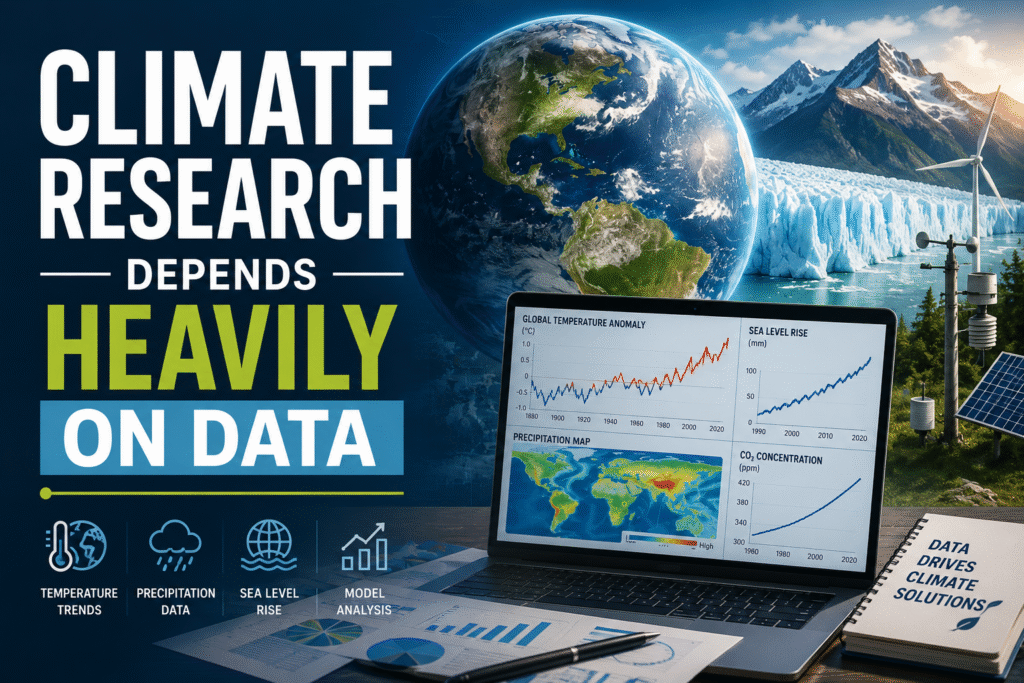
Climate science is another field where AI has become extremely valuable.
Environmental researchers collect nonstop information from satellites, oceans, forests, glaciers, weather stations, and atmospheric sensors around the world. The amount of environmental data available today is enormous.
That preparation can save lives.
Researchers are also using AI to track deforestation and pollution levels almost in real time. Years ago, environmental studies often depended on delayed reporting and manual observation. Now scientists can monitor changes much faster.
That speed matters because environmental damage is happening rapidly in many parts of the world.
AI Is Changing Space Research Too
Space exploration has always produced huge amounts of information, but modern technology increased the scale dramatically.
AI helps filter and analyze the data faster.
Without AI, some discoveries would probably take researchers years longer to notice.
There’s also growing interest in AIpowered robotics for future space missions. Since communication delays become a major problem in deep space, scientists are developing systems capable of making certain decisions independently.
That sounded like science fiction years ago, but it’s slowly becoming reality.
Genetics and DNA Research Are Moving Faster
Human DNA contains an enormous amount of biological information. Studying genetic sequences manually is incredibly difficult and time-consuming and even technology is helping to resolve food crisis.
AI systems now help researchers analyze genetic data much faster than older methods allowed.
It’s already helping in things like cancer research, finding rare diseases earlier, and slowly moving healthcare toward more personalized treatments for patients.
AI is also being used with gene editing tools like CRISPR. Instead of going straight into lab work, researchers can first look at what machine learning predicts about how certain genetic changes might act. It doesn’t replace experiments, but it makes the whole process a bit faster and more focused.
That reduces risks and improves research accuracy.
Many experts believe the combination of AI and genetic science could completely reshape healthcare during the next few decades.
That’s dangerous.
Privacy is another concern, especially in medical research. AI systems often require access to huge amounts of personal information. Researchers must ensure that patient data remains protected and secure.
The Future of Scientific Research Will Not Be What It Used to Be
The way scientists work is already changing, and honestly, this is probably only the early stage of it.
A few years from now, AI will likely become a normal part of research instead of something people still describe as “advanced technology.” Researchers are building smarter systems that can process information faster, connect patterns more accurately, and handle scientific problems that would normally take humans years to figure out.
That could completely change how discoveries happen.
Things like medicine development, climate prediction, renewable energy research, and even space exploration may move much faster than they do today. Some scientists believe AI could help shorten research timelines that currently take decades.
That part cannot really be automated.
AI will probably become one of the most useful tools researchers have ever had, but tools still need people behind them. Scientists will continue making the important decisions, interpreting results, and deciding what should or should not be done.
So the future of scientific research probably won’t be humans competing against AI like movies often show.
It’ll look more like collaboration. Researchers use intelligent systems to work faster, test ideas more efficiently, and solve problems that once seemed impossible. And if things continue moving at the current pace, we’re probably nowhere near seeing the full potential of what AI could eventually contribute to science.