
I’ve been thinking about something lately that sounds simple but actually isn’t.
“How is it in 2026, with all the technology we have, smartphones, AI, satellites, robots, people are still hungry?”
I mean, you walk into a supermarket in a developed city and you’ll see more food than anyone can realistically eat. Rows of snacks, fruits from different countries, frozen meals, and fresh bread every morning. It almost feels like food is unlimited.
But then you look at the other side of the world, or even the same country sometimes, and you realize millions of people are struggling to get a proper meal.
That contradiction is uncomfortable. And honestly, it raises a big question:
Can technology actually fix this… or are we expecting too much from machines?
The uncomfortable truth first
Let’s be honest about something most people avoid.
The world doesn’t actually have a “lack of food” problem.
We already produce enough calories globally to feed everyone. The problem is that food doesn’t move evenly. It doesn’t reach everyone fairly. And sometimes it gets wasted before it even reaches a plate.
So when people say “food crisis,” it’s not just about farms producing less. It’s about systems breaking in different placestransport, storage, politics, money, even war and AI can certainly help.
That’s why this problem feels so stuck. It’s not one issue. It’s many small issues connected together.
So where does technology come in?
Technology doesn’t magically fix broken systems. But it can definitely improve them.
And honestly, it already is.
Take farming for example. A few decades ago, a farmer mostly depended on experience. You looked at the sky, checked the soil, and made a guess. That was it.
Now things are different.
Farmers can use satellite data to see crop health. Drones can fly over fields and show which area is drying or infected. Sensors in the soil can tell exactly how much water is needed.
That’s a big shift. It’s like going from guessing to knowing.
But here’s the kicker: it doesn’t always make farming any easier. Sometimes it makes it more complicated, especially for small farmers who can’t afford all this tech.
So technology helps… but only if people can access it.
AI in farming (sounds fancy, but it’s real)
Artificial intelligence is one of those things people talk about like it’s science fiction.
But in agriculture, it’s already being used in simple ways.
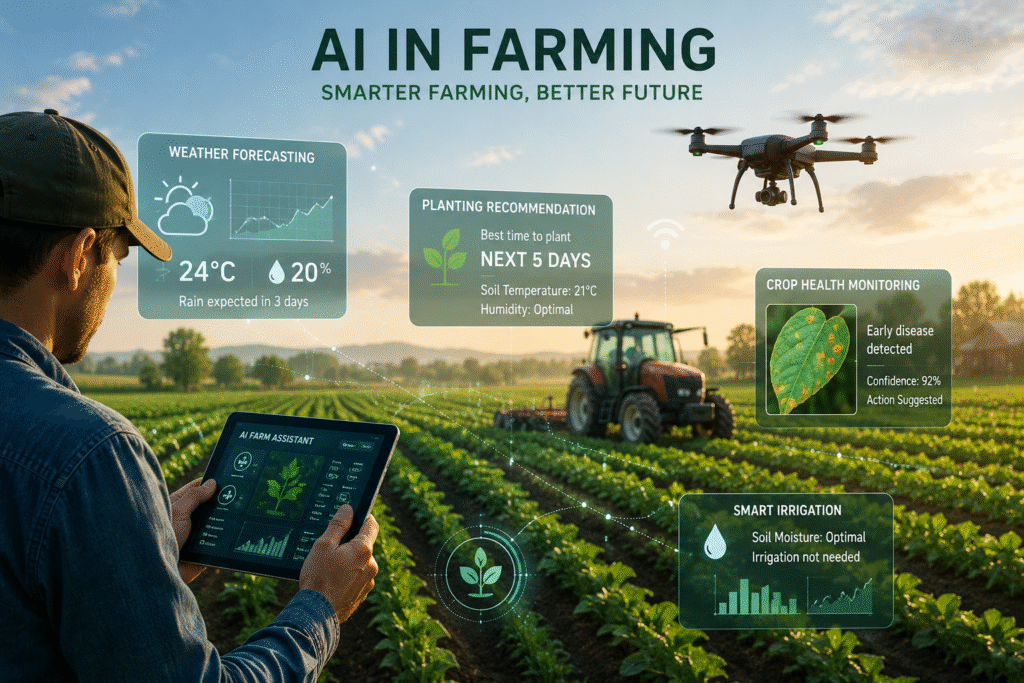
For example, AI can look at weather patterns and tell farmers when it might rain or when a dry spell is coming. It can suggest the best time to plant seeds. It can even detect disease in crops early just by analyzing images.
That sounds impressive, but let’s keep it realistic and it doesn’t replace farmers. It just helps them avoid mistakes.
Think of it more like a very smart assistant rather than a replacement.
And in farming, avoiding one mistake can mean saving an entire season.
Vertical farming – food without fields
Now this one always feels a bit futuristic.
Vertical farming is basically growing food indoors in stacked layers. No big fields, no traditional soil farming in many cases. Just controlled environments, LED lights, and water systems.
At first, it sounds strange. Like something from a sci-fi movie.
But it actually solves a real problem: space.
Cities are growing. Land is limited. And traditional farming can’t always keep up near urban populations.
So vertical farms try to bring food closer to people.
Imagine lettuce grown inside a building in your city instead of being transported hundreds of kilometers. Less travel, less spoilage.
But again there’s a catch.
It’s expensive. Very expensive. So right now it’s not feeding the world. It’s more like an experiment for the future.
The biggest hidden problem: waste
This is the part that honestly frustrates me the most.
A huge amount of food never even gets eaten.
Not because it’s bad, but because of timing, storage, or overbuying.
Farmers sometimes lose crops because they can’t store them properly. Supermarkets throw away food that’s still fine. Households buy too much and forget it in the fridge.
It’s estimated that a huge portion of food gets wasted globally. Some say even up to a third.
Just think about that for a second.
One out of every three meals worth of food… gone.
And technology is actually helping here in a very practical way.
Better storage systems, apps that sell leftover restaurant food, smart tracking systems in warehousesall of this reduces waste quietly in the background.
It’s not flashy, but it matters a lot.
Robots and machines in farming
Another big change is automation.
You might not picture robots in fields, but they’re already there in some countries.
Machines can pick fruits, plant seeds, spray fertilizers, and even monitor crops. Drones can scan huge farms in minutes.
This helps because in many places, fewer people want to do farm work. It’s hard labor, and younger generations often move to cities.
So machines fill that gap.
But again, there’s a debate here. Some people worry about jobs disappearing. Others say it’s necessary because there simply aren’t enough workers.
Both sides have a point.
But let’s not get carried away
Here’s where I want to slow down a bit.
It’s easy to think technology will “fix everything.” But that’s not how reality works.
Because hunger is not just a farming problem.
It’s also about poverty. If someone can’t afford food, it doesn’t matter how much technology exists. It’s also about war in some regions. It’s about poor roads, lack of storage, corruption in supply chains, and weak governments.
Technology can’t fix those things alone.
And sometimes, it even increases inequality. Big companies can afford advanced systems. Small farmers can’t. So the gap can grow wider if we’re not careful.
So what’s the real answer?
If I had to answer honestly not in a textbook way, but just as a normal observation it would be this:
Technology can reduce the global food crisis, but it cannot eliminate it on its own.
It can make farming smarter.
It can reduce waste.
It can improve distribution.
It can help farmers survive climate change.
But it still depends on humans to decide how fairly it is used.
Because at the end of the day, food is not just a technical issue. It’s a human one.
And maybe that’s the part we forget most often.
Technology can grow food. But only people can make sure it reaches everyone.