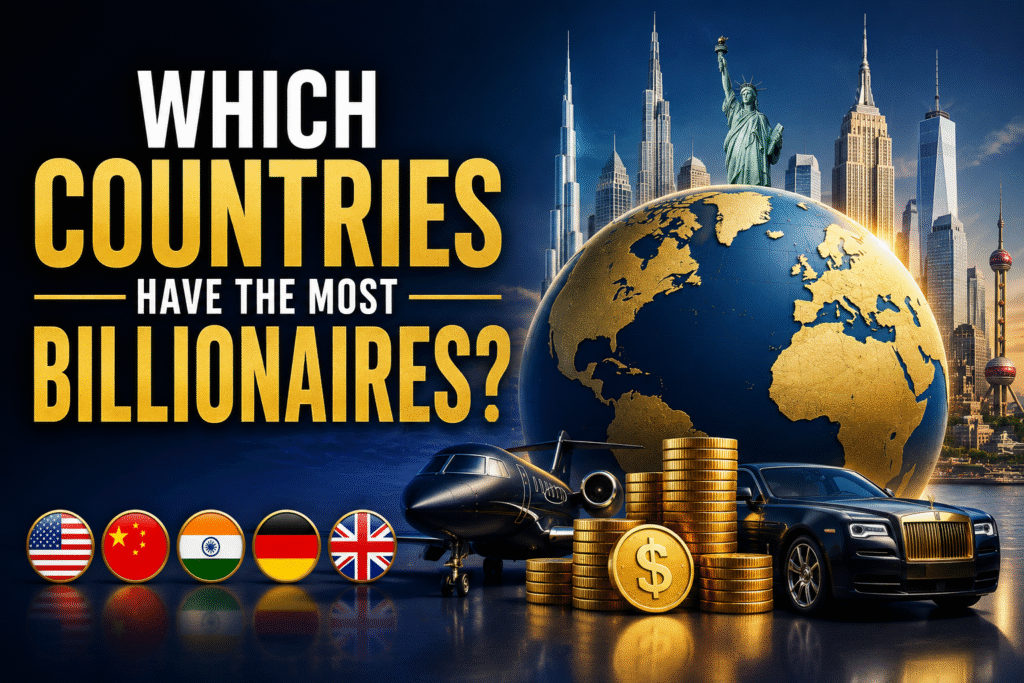

When we hear the word “billionaire,” most of us immediately think of famous names such as Elon Musk, Jeff Bezos, Mark Zuckerberg or Mukesh Ambani. Their companies, lifestyles and business decisions regularly appear in the news. But billionaires are not spread evenly across the world. A large share of them live in just a handful of countries.
According to the Forbes World’s Billionaires List published in March 2026, the world now has a record 3,428 billionaires. Together, their estimated wealth stands at around $20.1 trillion. That is an almost unimaginable amount of money, larger than the yearly economic output of many major countries combined.
The United States remains the clear leader on the Forbes list, followed by China and India. Germany, Russia, Canada and several other countries also have surprisingly large billionaire populations.
These numbers tell us more than simply where rich people live. They also point to where businesses are expanding, where investors can obtain capital and what industries are creating the most fortunes.
Why Do Billionaire Numbers Change So Often?
Before looking at individual countries, it is important to understand that billionaire rankings are not permanent.
A person may be worth $1.2 billion today and less than $1 billion a few months later. Share prices rise and fall, private companies receive new valuations, currencies move and business owners buy or sell major assets. Because so much billionaire wealth is tied to company shares, even one difficult week in the stock market can remove billions of dollars from someone’s estimated fortune.
Forbes calculates wealth by studying shareholdings, private businesses, property, investments and other identifiable assets. Known debts are then deducted. Public company shares are valued according to market prices around the date when the list is prepared. That means the annual ranking is best understood as a financial snapshot, not a permanent measurement.
Still, here are the countries and territories with the most billionaire citizens in the Forbes 2026 rankings.
1. United States — 989 Billionaires
The United States is still the world’s biggest home for billionaires, with 989 billionaire citizens on the 2026 Forbes list. It is close to crossing the remarkable mark of 1,000 billionaires in a single country.
This position is not particularly surprising. The US has the world’s deepest capital markets, a powerful technology sector and a long history of supporting entrepreneurship. A successful American company can raise money from venture-capital firms, private investors and public stock markets. When such a company grows rapidly, its founders and early investors can become extremely wealthy.
Technology has been a major contributor to the creation of American billionaires. Companies connected to artificial intelligence, software, online advertising, cloud computing, social media, tourism, electric vehicles and space technology have generated enormous fortunes.
But technology is not the only source of American wealth. The country also has billionaires in finance, retail, property, sports, entertainment, oil, food and healthcare. Some built their companies from the ground up, while others inherited large family businesses.
Another reason for America’s lead is that it attracts entrepreneurs from around the world. Hurun’s 2026 research shows 175 billionaires in the United States were born outside the country, a testament to how immigration has been part of the business and investment culture in the country. Even USA has the most powerful military.
2. China — 539 Billionaires
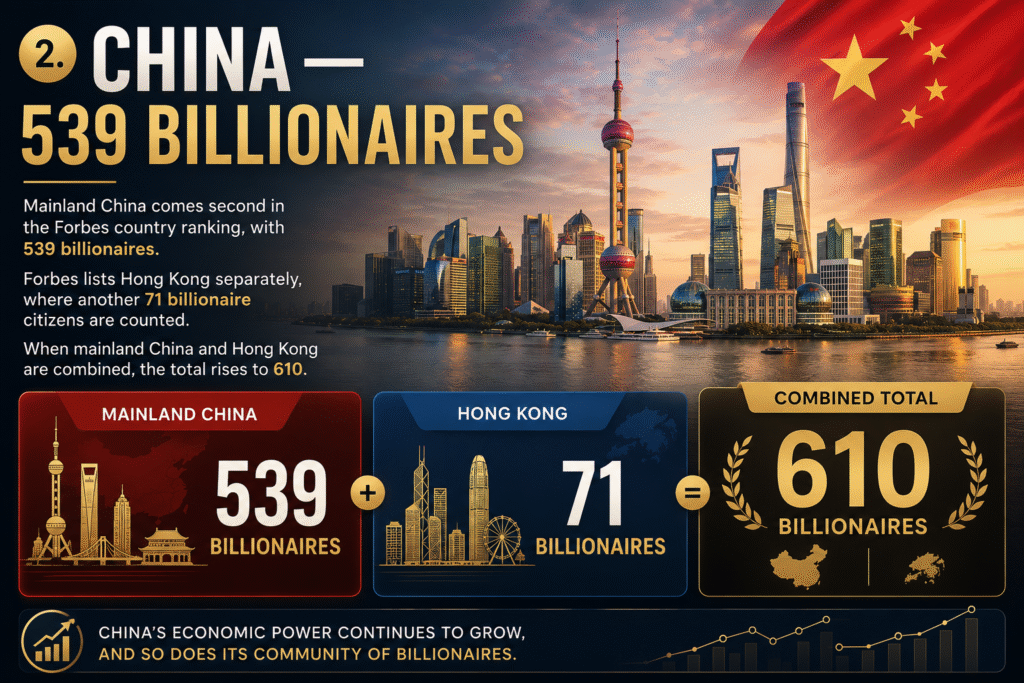
Mainland China comes second in the Forbes country ranking, with 539 billionaires. Forbes lists Hong Kong separately, where another 71 billionaire citizens are counted. When mainland China and Hong Kong are combined, the total rises to 610.
China’s billionaire growth is closely connected to the country’s transformation into a global manufacturing and technology centre. Over the past few decades, Chinese entrepreneurs have built major companies in e-commerce, property, electric vehicles, batteries, consumer electronics, social media, healthcare and industrial manufacturing.
The country has become especially important in areas such as renewable energy, semiconductors, robotics and electric-car supply chains. Some Chinese fortunes come from companies that sell directly to consumers, while others were created by less famous industrial businesses supplying materials, components and machinery.
However, billionaire wealth in China can change quickly. Government regulations, property-market problems and movements in Chinese and Hong Kong share prices have caused major shifts in past rankings.
Interestingly, not every wealth report agrees that the United States is number one. The Hurun Global Rich List 2026 counted 1,110 billionaires in China and 1,000 in the United States, placing China first. Hurun uses its own valuation date and methodology, so its figures differ from Forbes.
This difference is a useful reminder that billionaire rankings are estimates. Researchers may classify citizenship, residence, family wealth and private-company ownership differently.
3. India — 229 Billionaires
India holds third place on the Forbes list with 229 billionaires. Their combined fortune is estimated at approximately $1 trillion.
India’s position reflects the huge size of its economy and population. The country has successful companies in energy, telecommunications, infrastructure, technology, pharmaceuticals, banking and consumer goods.
Mukesh Ambani and Gautam Adani are among the best-known Indian business figures, but India’s billionaire community is much wider than these two names. Wealth is being created through software services, online businesses, manufacturing, hospitals, retail chains and financial technology.
India also has an enormous domestic market. A company does not always need to become popular in Europe or America to reach millions of customers. It can grow by serving Indian consumers alone.
At the same time, much of India’s wealth remains concentrated among a relatively small section of society. The country’s billionaire growth exists beside poverty, unemployment and unequal access to education and healthcare. This makes conversations about extreme wealth more complicated than simply celebrating business success.
4. Germany — 212 Billionaires
Germany ranks fourth with 212 billionaires, a major increase from the previous year.
German wealth often looks different from the technology-centred wealth found in the United States. Many German fortunes are linked to manufacturing, retail, automotive businesses, chemicals, healthcare and long-established family companies.
Germany is famous for its “Mittelstand” businesses. These are often specialised, privately owned companies that may not be widely recognised by ordinary consumers but are highly successful in their industries. Some manufacture machinery, industrial parts or technical products used around the world.
Germany’s large billionaire population shows that new apps and social-media platforms are not the only paths to great wealth. Traditional industries can still create huge fortunes when they are well managed and operate internationally.
5. Russia — 147 Billionaires
Russia has 147 billionaires, placing it fifth in the Forbes ranking.
A significant amount of Russian billionaire wealth comes from natural resources and heavy industry. Oil, gas, mining, metals, chemicals and banking have produced many of the country’s largest fortunes.
Russia’s billionaire numbers must be viewed within the country’s unique political and economic environment. Sanctions, international restrictions, ownership structures and the difficulty of valuing certain assets can make Russian fortunes harder to calculate.
Changes in the Russian ruble can also affect how wealth appears when measured in US dollars. A businessperson may still own the same factories or shares, but a large movement in the exchange rate can raise or reduce the dollar value of those assets.
6. Canada — 89 Billionaires
Canada may have a much smaller population than the United States, China or India, but it still has 89 billionaires. Their combined wealth is estimated at around $483 billion.
Canadian fortunes come from media, retail, finance, technology, property, mining and natural resources. The country benefits from political stability, strong financial institutions and close trading links with the United States.
Canada is also attractive to wealthy immigrants and international investors. Cities such as Toronto and Vancouver have become important centres for business, property investment and financial services.
Its presence near the top of the list proves that population size alone does not determine how many billionaires a country produces. Access to investment, legal stability and international markets can be equally important.
7. Italy — 82 Billionaires
Italy has 82 billionaires, giving it seventh place.
The country’s wealth is connected to fashion, luxury goods, manufacturing, pharmaceuticals, food, property and family-owned businesses. Italy is home to globally recognised brands, but many of its successful companies remain controlled by the families that founded them.
Italian billionaires are a good example of how cultural industries can become serious economic engines. Fashion, jewellery, design and premium food products may appear creative or artistic, but they can support international businesses worth billions of dollars.
Italy also has a long tradition of passing businesses from one generation to the next. As a result, inherited wealth and family ownership remain important parts of the country’s billionaire landscape.
8. Hong Kong — 71 Billionaires
Hong Kong has 71 billionaire citizens in the Forbes ranking.
For many years, the territory has served as one of Asia’s most important financial and trading centres. Its billionaire fortunes are strongly linked to property, ports, retail, finance, hotels and investments.
Hong Kong’s limited land and expensive property market helped create extraordinary real-estate fortunes. Several of its richest families built wealth by developing commercial buildings, residential towers, shopping centres and large infrastructure projects.
Forbes lists Hong Kong separately from mainland China. This is why some reports say China has 539 billionaires while others combine the two figures and report 610.
9. Brazil — 70 Billionaires
Brazil ranks ninth with 70 billionaires, up from 56 in the previous Forbes ranking. Their total estimated wealth is around $265 billion.
Brazil is the only Latin American country in the Forbes top ten. Its billionaire fortunes come from banking, investment, food, mining, retail, technology and manufacturing.
The country has a large population, rich natural resources and one of the region’s biggest consumer markets. These advantages create enormous business opportunities. At the same time, Brazil faces high inequality, meaning its billionaire wealth exists beside serious economic difficulties for many ordinary families.
Brazil’s position is therefore both a sign of economic strength and a reminder that national wealth is not always shared evenly.
10. Taiwan — 66 Billionaires
Taiwan completes the top ten with 66 billionaires, replacing the United Kingdom in the 2026 Forbes ranking.
Its rise is closely connected to electronics and semiconductor manufacturing. Taiwan plays a critical role in the global technology supply chain. Its companies produce advanced chips and electronic components used in phones, computers, vehicles, data centres and artificial-intelligence systems.
Taiwan’s success is particularly impressive because of its relatively small population and geographical size. It has created a highly specialised economy that supplies products the rest of the world depends on.
The growing demand for artificial-intelligence hardware has made Taiwan even more important. As investment in chips and data centres increases, the value of businesses operating in this sector can rise quickly.
What Do These Countries Have in Common?
The countries on this list are very different, but most of them share a few important advantages.
They have large consumer markets, strong financial systems, valuable natural resources or specialised industries. Many also have stock exchanges and investment networks that allow successful businesses to raise money and expand.
Technology is now one of the most visible billionaire-producing forces, especially in the United States, China and Taiwan. Hurun reported that artificial-intelligence companies created 46 new billionaire entrants in its 2026 ranking alone.
However, traditional industries remain extremely powerful. Manufacturing creates billionaires in Germany and China. Energy and mining create fortunes in Russia, India, Canada and Brazil. Fashion and luxury goods remain important in Italy, while property and finance have produced major fortunes in Hong Kong.
This shows that there is no single road to billionaire status.
Does Having More Billionaires Mean a Country Is Doing Better?
Not necessarily.
A country with many billionaires may have successful companies, active financial markets and strong opportunities for entrepreneurs. Billionaires can create jobs, fund new technology and invest in major projects.
But a high billionaire count does not automatically mean that ordinary people are financially comfortable. A country can have hundreds of billionaires while millions of citizens struggle with housing costs, low wages, inflation or limited healthcare.
That is why billionaire rankings should not be treated as simple national scoreboards. They show where extreme private wealth is concentrated, but they do not tell us how fairly wealth is distributed.
The most important question is not only how many billionaires a country has. It is also whether economic growth improves life for workers, small-business owners and middle-income families.
Final Thoughts
The billionaire map of the world is dominated by three countries: the United States, China and India. The United States leads the 2026 Forbes ranking with 989 billionaires, while mainland China follows with 539 and India holds third place with 229.
Germany and Russia remain major centres of industrial and resource-based wealth. Canada, Italy, Hong Kong, Brazil and Taiwan complete the top ten, each reaching the list through a different mix of industries and economic advantages.
These rankings will continue to change. New technologies will create fresh fortunes, older companies will lose value and billionaires may move between countries. Artificial intelligence, semiconductors, renewable energy, digital finance and advanced manufacturing are likely to play an even bigger role in future lists.
Behind all the impressive figures, however, remains a much larger debate. Billionaires can represent innovation, ambition and business success, but their growing wealth also raises difficult questions about inequality and economic power. Perhaps that is why billionaire rankings attract so much attention. They are not simply lists of rich people. They are snapshots of where the world’s money, businesses and influence are moving.