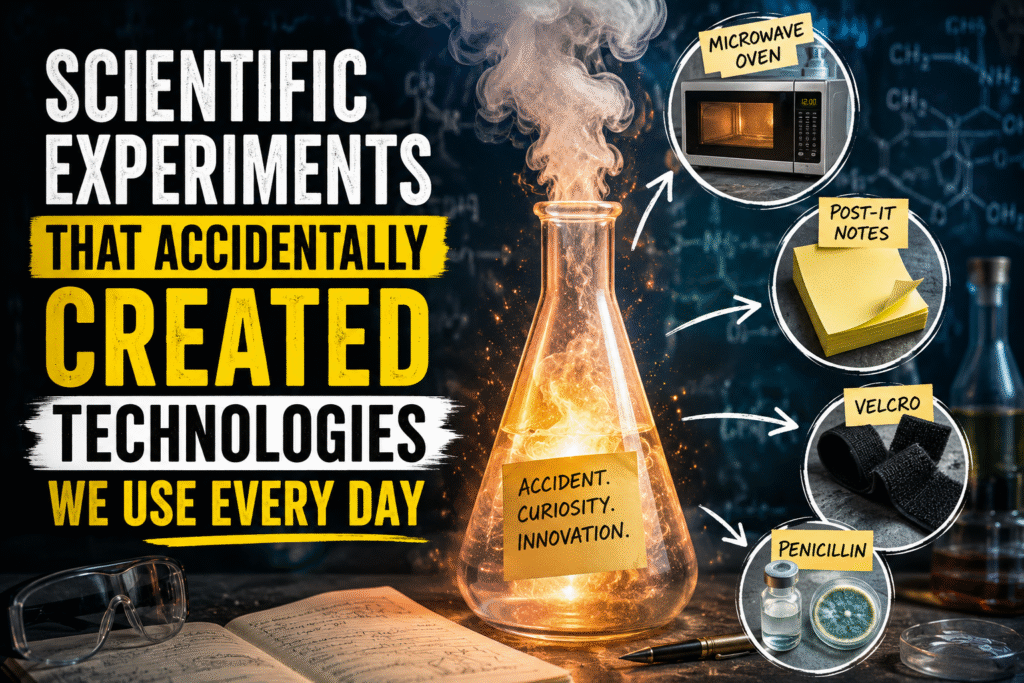

A scientist works day and night, mixes a few chemicals, and suddenly creates something revolutionary that changes the world forever.
Real life is rarely that clean.
A surprising number of important inventions were discovered completely by accident. Some came from failed experiments. Others happened because researchers noticed strange things that were never supposed to happen in the first place. In a few cases, discoveries were almost thrown away because scientists thought the experiment had gone wrong.
Scientists were often trying to solve one problem and accidentally ended up solving a much bigger one.
And honestly, if a few people had ignored those weird moments, modern life could look very different today.
Penicillin Began With a Contaminated Experiment
One of the most important discoveries in medical history started because a laboratory sample became contaminated.
In 1928, Alexander Fleming returned to his lab after spending time away and noticed mold growing inside one of his petri dishes.Normally, tainted samples are useless. Most researchers would throw them away immediately without thinking twice.
But something about this dish caught Fleming’s attention.
The bacteria around the mold had disappeared.
At first, it probably looked more strange than revolutionary. Still, Fleming decided to study it instead of tossing it into the trash. That decision eventually led to penicillin, the world’s first major antibiotic.
It is difficult to explain how dangerous infections were before antibiotics existed. People died from illnesses that are easily treatable today. Even a small wound might become life-threatening if infection spreads across the body. Surgery was risky too because doctors had very limited ways to control bacterial infections.
Penicillin completely changed medicine.
The strange part is that the discovery happened because something went wrong in a laboratory.
The Microwave Oven Exists Because of Melted Chocolate
The origin story of microwave ovens honestly sounds made up, but it is completely real.
During the 1940s, engineer Percy Spencer was working with radar-related equipment when he noticed the chocolate bar in his pocket had melted unexpectedly.
Most people would probably just clean the mess and continue working.
Spencer became curious instead.
He started experimenting with food near the equipment. Popcorn kernels began popping almost instantly. Other foods heated unusually fast too. At one point, an egg reportedly exploded during testing.
That was the moment researchers realized microwave radiation could heat food quickly.
Nobody involved was trying to invent a kitchen appliance at the time. The original work focused on radar technology connected to military research. But one unexpected observation completely changed the direction of things.
The first microwave ovens were enormous. They were expensive, heavy, and looked more like industrial machines than something you would place beside your refrigerator.
Now they sit quietly in millions of kitchens around the world.
Pretty strange when you think about it.
The first X-ray image he created showed the bones inside his wife’s hand. People were stunned by it. Imagine living in a world where humans had never seen inside the body without surgery before.
Today X-rays are used in hospitals, dental clinics, airports, factories, and scientific research centers across the world. Most people have experienced them at least once without thinking much about how unusual the original discovery really was.
Sticky Notes Came From a Failed Experiment
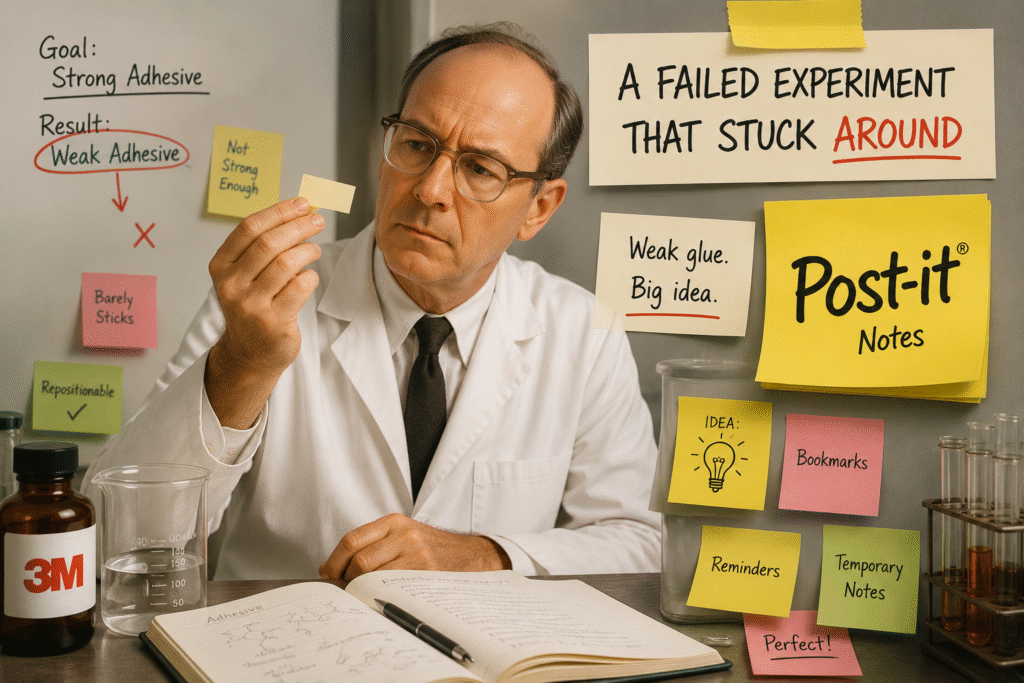
Some inventions succeeded specifically because the original experiment failed.
In the 1960s, chemist Spencer Silver was trying to create a very strong adhesive while working at 3M. Instead, he accidentally developed a weak glue that barely stuck properly.
At first, the experiment looked useless. AI can help in solving global food crisis.
After all, a weak adhesive sounded like the exact opposite of what researchers wanted.
Years later, another employee named Art Fry realized the weak adhesive could solve a surprisingly annoying problem. He wanted bookmarks that stayed inside pages without damaging them when removed.
That idea eventually became the Post-it Note.
It is funny because the invention worked precisely because the glue was weak. If the experiment had succeeded normally, sticky notes might never have existed at all.
Now they are everywhere.
Offices, classrooms, bedrooms, laptops, refrigerators.
The Internet Had a Much Smaller Beginning
The internet feels massive today, but its beginnings were surprisingly technical and limited.
Honestly, the original researchers probably would not recognize today’s internet at all.
What began as a technical communication project slowly expanded into something much larger than anyone expected.
Entire industries exist because of those early experiments.
Teflon Was Accidentally Created in a Chemistry Lab
Another important invention appeared because an experiment behaved strangely.
In 1938, Roy Plunkett was experimenting with refrigeration gases when one of his containers stopped working properly.
The gas would not come out.
Electricity Experiments Quietly Changed Civilization
Long before electricity powered cities, scientists were simply curious about how it worked.
Scientists like Michael Faraday and Nikola Tesla spent many years doing experiments with electricity. They were simply experimenting with things like electric currents, magnets, and figuring out how energy travels from one place to another.It wasn’t fully clear to them where all of this would lead.
In the old days electricity was very unusual, it was like magic to most people, it felt unusual… almost like something magical.
Now, almost everything around us runs on electricity in one way or another.Things like computers, phones, transport, factories, lights, fridges basically daily life would not work without it.
Which is honestly incredible when you remember that it all started with scientists experimenting out of curiosity.
Space Research Accidentally Improved Everyday Life
A lot of technologies used in normal daily life actually came from scientific research connected to space exploration.
How do humans survive in space? How do you even communicate properly when everything is so far away? And what kind of materials can survive those conditions?
While figuring all that out, they didn’t really plan it, but they ended up creating a lot of things that later became useful here on Earth too.
Things like memory foam, water cleaning systems, infrared thermometers, lighter materials, and even improvements in camera technology all came from that kind of research. A lot of the cameras in smartphones today are better because of imaging ideas that were first tested for space missions.
It’s kind of funny when you think about it. Most people don’t even connect their phone camera or mattress with space science, but in reality, space research is quietly part of daily life.
Curiosity Is What Pushes Science Forward
When you look at all these inventions together, one thing starts to make sense.
Science doesn’t really follow a perfect plan all the time. Even some green technologies invented without proper planning and experimentation.
A lot of important discoveries happened just because someone noticed something weird and didn’t ignore it. The experiment might have been going in a completely different direction, but that one unusual result changed everything.
And honestly, that still happens today. Scientists working on AI, clean energy, medicine, and other new technologies are probably making small discoveries right now that could become huge in the future. We just don’t know it yet.
That’s what makes science exciting. You never really know what a simple experiment or idea can turn into later on.