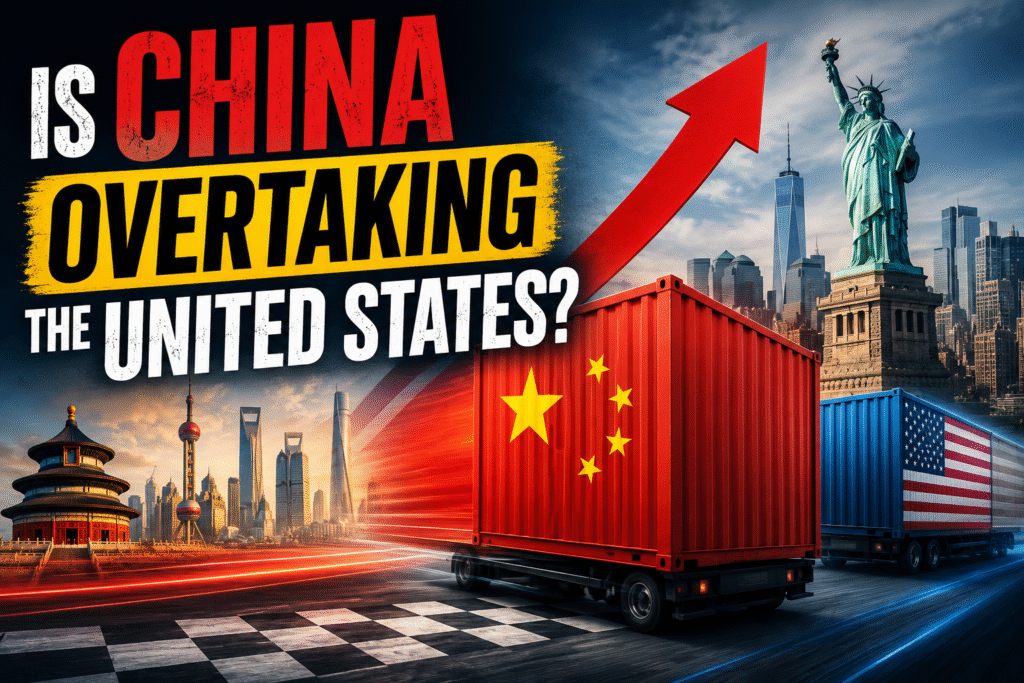

For many years, people have asked one big question: is China overtaking the United States? It is not a simple yes or no question. In some areas, China is already ahead. In other areas, the United States is still far stronger. The real answer depends on what we mean by “overtaking.” Are we talking about economic size, military power, technology, global influence, quality of life, currency power, or long-term stability?
China’s rise is one of the biggest stories of modern history. In just a few decades, it moved from being a poor, mostly rural country to becoming the world’s second-largest economy, the biggest manufacturing power, a major military force, and a serious technology competitor. The United States, on the other hand, remains the world’s most powerful country in many traditional areas: global finance, military reach, top universities, innovation ecosystems, alliances, soft power, and the dominance of the U.S. dollar.
So, is China overtaking America? The honest answer is this: China is catching up fast in many areas, and in some sectors it has already passed the United States. But overall, the United States is not finished, and China has serious problems of its own.
China’s Economic Rise Is Real
The first reason people believe China is overtaking the United States is the economy. China’s growth over the last forty years has been extraordinary. It became the factory of the world, built massive cities, lifted hundreds of millions of people out of poverty, and created companies that compete globally.
According to World Bank data, China’s GDP in current U.S. dollars was about $19.5 trillion in 2025, while the United States was still larger at about $30.8 trillion. China’s annual GDP growth was listed at 5.0%, compared with 2.2% for the United States. This shows the basic difference between the two economies: America is still bigger in dollar terms, but China has been growing faster.
However, GDP alone does not tell the full story. China has a much larger population, so when we look at GDP per person, the United States remains far ahead. The World Bank listed China’s GDP per capita at around $13,862 in 2025, compared with about $90,026 for the United States. That gap matters because it shows that the average American still lives in a much richer economy than the average Chinese citizen and these both countries have great military power.
This is why China can look extremely powerful at the national level but still face many middle-income challenges at the household level. A country can have huge total output and still have lower average income, weaker consumption, and more pressure on ordinary families.
China Has Become the World’s Manufacturing Giant
If there is one area where China has clearly overtaken the United States, it is manufacturing scale. China is not just producing cheap goods anymore. It is producing electric vehicles, solar panels, batteries, telecom equipment, machinery, drones, ships, electronics, and industrial components at a scale few countries can match.
This manufacturing strength gives China real power. It can build infrastructure quickly. It can export products across the world. It can dominate supply chains. It can also use industrial policy to support strategic sectors. This is one reason many Western countries worry about depending too much on Chinese production and China has excellent healthcare facilities.
The United States still has advanced manufacturing in areas like aerospace, semiconductors, defense, medical technology, and high-end software-driven industries. But America allowed much of its lower and middle-level manufacturing base to move overseas over several decades. China took advantage of that shift and became deeply connected to global production.
In simple words, America still leads in many high-value technologies, but China often leads in the ability to produce at huge scale and lower cost. That is a powerful advantage.
Technology: China Is Closing the Gap
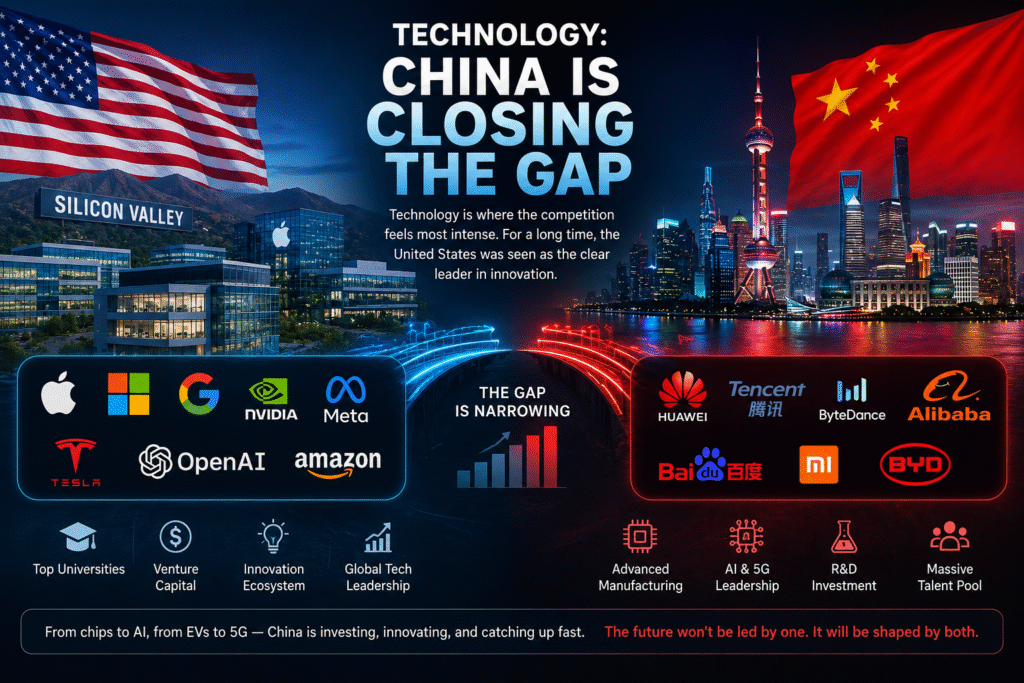
Technology is where the competition feels most intense. For a long time, the United States was seen as the clear leader in innovation. Silicon Valley, American universities, venture capital, and companies like Apple, Microsoft, Google, Nvidia, Meta, Tesla, OpenAI, and Amazon gave the U.S. a massive advantage.
But China is no longer just copying technology. It is creating its own. Chinese companies are strong in electric vehicles, batteries, solar technology, e-commerce, mobile payments, drones, telecom equipment, robotics, and increasingly artificial intelligence. China is also spending heavily on research and development.
OECD data shows China’s R&D spending growth far outpaced the United States in 2023. China’s R&D expenditure grew by 8.7%, compared with 1.7% for the United States, and China’s R&D level in purchasing power parity terms reached 96% of the U.S. level.
China also entered the top 10 in the Global Innovation Index for the first time in 2025, according to the World Intellectual Property Organization, which cited China’s rising strength in R&D, high-tech exports and innovation outputs.
Still, the United States has advantages that are hard to replace. It attracts global talent. It has deeper capital markets. It has many of the world’s leading universities. It has a stronger startup culture. It also remains dominant in advanced chips, cloud computing, frontier AI models, biotech, and high-end software ecosystems.
So China is not simply “behind” anymore. It is now a serious rival. But the U.S. still leads in many frontier areas where breakthroughs are born and China has a rank of number 2 as far as most billionaires are concerned.
Military Power: China Is Stronger, But America Is Still Ahead
China’s military has modernized quickly. Its navy has expanded, its missile forces are more advanced, and its power in the Western Pacific has grown. China wants to make sure the United States cannot easily dominate near China’s coast, especially around Taiwan and the South China Sea.
But globally, the United States still has the stronger military network. It has aircraft carriers, overseas bases, military alliances, advanced intelligence systems, nuclear power, and decades of combat and logistics experience. The American military is built not only to defend U.S. territory, but to operate around the world.
SIPRI reported that the United States spent about $954 billion on its military in 2025, while China spent about $336 billion. China was the world’s second-largest military spender, and its spending rose for the 31st consecutive year, but the U.S. still spent far more.
The important point is this: China may be getting strong enough to challenge the U.S. regionally, especially in Asia. But the United States still has greater global military reach.
The U.S. Dollar Is Still a Huge American Advantage
One of America’s biggest strengths is not a weapon or a factory. It is the dollar.
The U.S. dollar remains the center of global finance.Countries trade in dollars, hold dollars in reserves, borrow dollars, use the American financial system. The United States has tremendous leverage. It also means America can borrow easier than most countries.
China has tried to internationalise the yuan more, but progress is limited. The SWIFT’s RMB Tracker shows that the Chinese yuan was the sixth most active currency for global payments by value in June 2025, with a share of 2.88%. That’s important, but it’s a long way from replacing the dollar.
And this is one area where China has not surpassed the United States. The dollar system relies on trust, on liquidity, on open capital markets, on legal systems and on decades of global use. China’s financial system remains more controlled and many investors are wary of political risk, transparency and capital restrictions.
The Demographics Dilemma for China
China looks strong as it rises, but has a serious long-term problem: its population is shrinking and getting old. A smaller workforce can impede growth, increase pressure on pensions, reduce consumption and make it harder to sustain high-speed growth.
China’s National Bureau of Statistics reported that by the end of 2025, China’s population fell to 1,404.89 million, a decrease of 3.39 million from the end of 2024. It also reported 7.92 million births and 11.31 million deaths in 2025.
The United States also has demographic challenges, but it has one major advantage: immigration. The U.S. Census Bureau estimated the U.S. population to be 341.8 million in 2025, an increase of 1.8 million people from July 2024 to July 2025.
This matters because long-term power is not just about factories and missiles. It is also about workers, consumers, taxpayers, entrepreneurs, and young people. China’s aging population may become one of the biggest limits on its rise.
Global Influence: China Has Money, America Has Alliances
China has increased its influence through trade, infrastructure, investment, and diplomacy. China is seen as an important economic partner by many countries in Asia, Africa, Latin America and the Middle East. Through projects, loans, ports, railways and trade routes, China has developed close ties across the developing world.
But the United States still has something China does not have at the same level: a deep alliance network. NATO, Japan, South Korea, Australia, Canada, the United Kingdom, and many European partners still give America a global strategic advantage. These alliances are not always perfect, and sometimes U.S. politics creates uncertainty, but the network still matters.
China has partners, but fewer true allies. Many countries want Chinese trade, but they do not necessarily want Chinese political leadership. That is an important difference.
So, Is China Overtaking the United States?
China is overtaking the United States in some specific areas. It has already passed America in manufacturing scale. It is a major competitor in electric vehicles, batteries, solar panels, infrastructure, and some areas of applied technology. It is also becoming more powerful militarily in its own region.
But the United States is still ahead overall. It has a larger economy in nominal dollar terms, a much richer population, the world’s leading currency, stronger global alliances, deeper capital markets, top universities, a more attractive immigration system, and stronger global military reach.
The better way to understand this competition is not to ask, “Will China replace America?” A better question is: “How much of America’s old dominance will China reduce?”
The world is moving from a one-superpower moment to a more competitive system. China is no longer weak. America is no longer unchallenged. Both countries have strengths, and both have weaknesses.
China’s rise is real, but it is not guaranteed to continue smoothly. In the end, China is not fully overtaking the United States yet. But it is forcing the United States to compete harder than it has in decades. That alone shows how much the world has changed.