
Gold has always had a special role in human history. People buy it for weddings , investors keep it during uncertain times and governments keep it as part of their national reserves . But something interesting has happened in the past few years. Central banks have been purchasing gold at a much faster rate.
This is not simply because gold looks valuable. Countries use it as a financial safety net. Unlike foreign currency reserves or government bonds, physical gold does not depend on another country keeping a promise. It cannot be printed, frozen as easily as money held abroad, or weakened directly by another government’s monetary policy.
Central banks and other official institutions purchased an estimated 863 tonnes of gold in 2025. This was lower than the unusually high level of more than 1,000 tonnes recorded in each of the previous three years, but it was still far above the annual average seen between 2010 and 2021.
So, which countries are buying the most gold, and why are they doing it?
What Does “Buying Gold” Mean in This Ranking?
This article focuses mainly on gold purchased by central banks and official government institutions. It is not a ranking of jewellery demand, private investment or gold imports.
That difference is important. India and China, for example, have enormous consumer markets for jewellery, coins and gold bars. However, the buying discussed here refers to gold being added to official national reserves.
It is also worth noting that central-bank data are not always complete. According to the World Gold Council, unreported buying represented a large part of estimated official gold demand in 2025. Some institutions announce their purchases immediately, while others report them months later or do not clearly disclose them at all.
The figures below therefore show the largest publicly reported buyers rather than every purchase taking place behind the scenes.
1. Poland
Poland was the world’s largest reported gold buyer in 2025. The National Bank of Poland added approximately 102 tonnes during the year, increasing its total holdings to around 550 tonnes by the end of 2025. Gold represented roughly 28 percent of the country’s official reserves at that point.
Poland did not stop buying when the new year began. By May 2026, it had purchased another 64 tonnes, lifting its total gold reserves to around 614 tonnes. The central bank was moving closer to its stated target of holding 700 tonnes.
Poland’s actions show that its gold purchases are not temporary reactions to market movements. The country appears to see gold as a long-term part of its national financial security.
The extra gold for Poland could act as a hedge against currency instability, geopolitical tensions and wider economic shocks. Being in Eastern Europe, it never is far away from regional security concerns. Poland is among the countries where you can find best healthcare system.
2. Kazakhstan
Kazakhstan was another major buyer in 2025. Its central bank increased gold holdings by approximately 57 tonnes during the year, the largest annual purchase it had reported in records going back to 1993.
Kazakhstan is also an important gold-producing country. This gives its central bank the ability to purchase some gold from domestic producers rather than relying entirely on international markets.
The buying continued in 2026. By May, Kazakhstan had added a net 20 tonnes during the year, taking its official holdings to approximately 361 tonnes. Gold represented around 78 percent of its total reserves, making it a particularly important part of the country’s financial protection.
Kazakhstan has bought and sold gold at different times, partly because of its domestic production system. Still, its recent activity suggests that it wants to remain a significant gold holder while international tensions and economic uncertainty remain high.
3. Azerbaijan
Azerbaijan also made a major addition to its gold holdings. However, its purchases came through the State Oil Fund of Azerbaijan, commonly known as SOFAZ, rather than its central bank.
SOFAZ purchased approximately 53 tonnes of gold during 2025. This made Azerbaijan one of the largest publicly identified official-sector buyers of the year. In the first quarter of 2026, however, the fund sold around 22 tonnes, partially reversing its earlier purchases.
Azerbaijan earns substantial income from oil and gas. Converting part of that wealth into gold allows the country to diversify instead of keeping too much of its savings in energy-related assets, foreign currencies or overseas securities.
Its activity also demonstrates that official gold reserves are not always kept permanently. Governments and sovereign funds sell when they need liquidity, when they want to rebalance their investments or when they decide to take advantage of higher prices.
4. Brazil
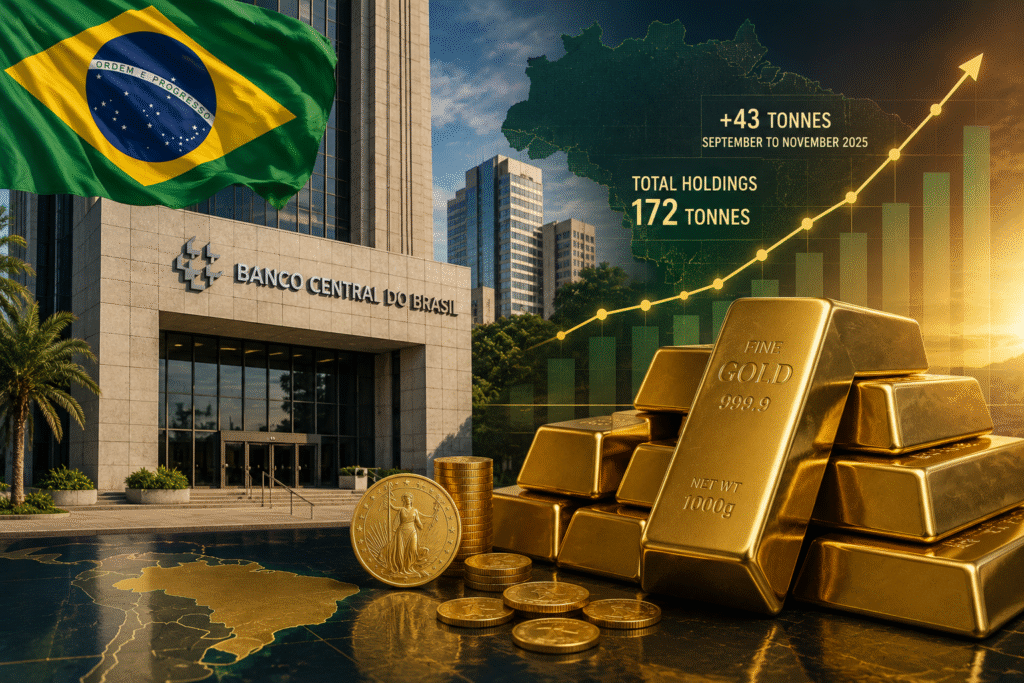
Brazil returned to the gold market in 2025 after several years without making a major reported purchase.
The Central Bank of Brazil added approximately 43 tonnes between September and November. Its total holdings reached around 172 tonnes, although gold still represented only about 7 percent of the country’s total reserves.
That relatively small percentage is important. Brazil has a large pool of foreign reserves, so the country still has room to increase its gold allocation without making gold the dominant asset in its reserve portfolio.
Brazil’s return may also be part of a wider shift in Latin America. During the first months of 2026, Chile, Guatemala, Bolivia and Uruguay also reported additions to their gold holdings, although their purchases were much smaller.
Gold can offer a further cushion for emerging economies when global currencies, interest rates and conditions for international trade are volatile.
5. China
China already owns one of the largest official gold reserves in the world, but it continues to add more.
The People’s Bank of China purchased approximately 27 tonnes in 2025, bringing its reported holdings to around 2,306 tonnes by the end of the year. Even with such a large amount of gold, it represented only about 9 percent of China’s total reserves.
China’s buying became stronger during 2026. By May, it had added another 25 tonnes, taking reported holdings to approximately 2,331 tonnes. May also marked the twentieth consecutive month in which the central bank reported a net purchase.
China holds an enormous amount of foreign currency assets, including dollar-based reserves. Adding gold helps it spread risk across different assets. China is among the countries which keep the strongest and most powerful armies.
This does not mean China is suddenly replacing all its foreign currency reserves with gold. The economy and international trade relations are far too big for such a quick turnaround. Rather, it appears to be slowly and surely attempting to diversify.
6. Türkiye
Türkiye was also one of the leading reported buyers during 2025. Based on data available through October, the country added approximately 27 tonnes, taking its combined central-bank and Treasury holdings to around 644 tonnes.
Its position changed sharply in early 2026. Türkiye reported large sales and gold-related swap activity, with net sales reaching around 81 tonnes by May. Turkish officials indicated that much of this activity was connected with temporary gold-for-currency swaps, meaning some of the gold could later return to the reserves.
Türkiye’s experience shows why monthly gold figures need context. A reported fall does not always mean that a country has permanently lost confidence in gold. Central banks may temporarily use their gold to access foreign currency or manage financial pressure. Turkey is also among the most visited countries.
7. Czech Republic
The Czech Republic has been buying smaller amounts than Poland or Kazakhstan, but it has been remarkably consistent.
The Czech National Bank purchased approximately 20 tonnes in 2025, taking its holdings to around 72 tonnes by the end of the year. The bank has announced an objective of reaching 100 tonnes by 2028.
By May 2026, the Czech central bank had recorded 39 consecutive months of net gold buying. It added another two tonnes during May alone.
The Czech approach is less dramatic than making one enormous purchase. Instead, it is slowly building its holdings month after month. This reduces the risk of buying a very large amount at one particular price.
Uzbekistan Is Emerging as a Major Buyer in 2026
Uzbekistan deserves special attention because it became one of the leading buyers during the opening months of 2026.
By May, its central bank had purchased a net 33 tonnes during the year, placing it second behind Poland among reported buyers. Its total gold reserves represented around 87 percent of its overall reserves.
Uzbekistan is another gold-producing nation, so its holdings can rise and fall as the central bank purchases locally produced gold and later sells some of it internationally.
Because gold makes up such a large percentage of its reserves, even relatively small transactions can have a noticeable effect on the country’s official figures.
Why Are Central Banks Buying So Much Gold?
The biggest reason is uncertainty. Governments are dealing with wars, trade disputes, sanctions, inflation concerns, high debt levels and changing relationships between major global powers.
Gold is attractive because it is not issued by any government. It does not carry the same counterparty risk as a bond, bank deposit or foreign currency asset.
In the World Gold Council’s 2026 survey, 89 percent of participating central banks expected global official gold reserves to increase over the following 12 months. A record 45 percent expected their own institution’s holdings to rise. Crisis performance, diversification, inflation protection and geopolitical risk were among the main reasons given for holding or buying gold.
Many central banks are not abandoning the US dollar completely. They are simply trying not to depend too heavily on one currency, one government or one financial system.
Final Thoughts
Poland has clearly been the most aggressive publicly reported gold buyer, leading purchases in both 2025 and the first five months of 2026. Kazakhstan, Azerbaijan, Brazil, China, Türkiye and the Czech Republic were also important buyers during 2025, while Uzbekistan moved near the top of the list in early 2026.
However, the ranking can change quickly. Türkiye and Azerbaijan, for example, bought large amounts and later sold part of their holdings. Other countries may be purchasing gold without immediately reporting it.
The wider trend is more important than any single monthly figure. Central banks are treating gold as a serious strategic asset again.
In a world where currencies can lose value, foreign reserves can become politically sensitive and economic conditions can change without warning, a bar of gold offers something surprisingly simple: an asset that does not rely on another country’s promise. That does not make gold perfect, and it does not mean every country should place most of its reserves in it. But the continuing purchases show that even in a modern financial system filled with digital payments, complex bonds and global currencies, governments still find comfort in one of the oldest forms of wealth.