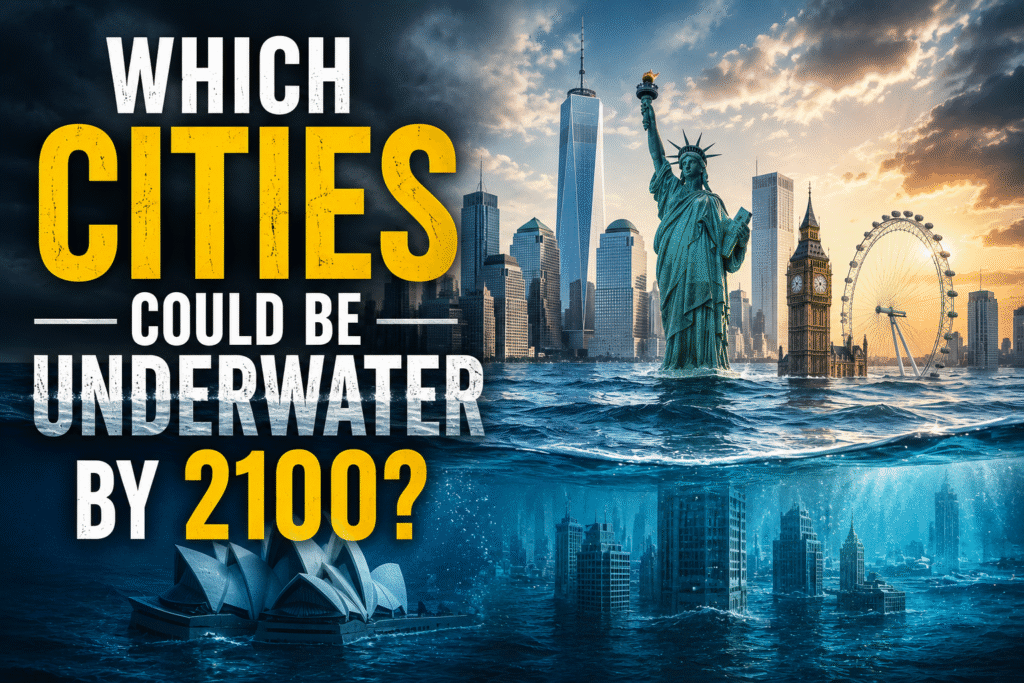

For most people, the idea of a city disappearing under the sea sounds like a scene from a disaster film. Streets become canals, famous buildings stand in deep water and millions of people are forced to leave their homes.
The reality is likely to be slower, more complicated and, in some ways, more worrying.
Most threatened cities will not suddenly vanish at the end of 2099. Long before then, they may experience regular tidal flooding, stronger storm surges, damaged roads, contaminated drinking water and neighbourhoods that become too expensive or unsafe to live in. Some areas may be protected by barriers and pumps, while others may eventually be abandoned.
The IPCC projects that global average sea level could rise by about 0.28 to 0.55 metres by 2100 under a very low-emissions pathway, or 0.63 to 1.01 metres under a very high-emissions pathway, compared with the 1995–2014 average. Local changes may be higher or lower because some land is sinking, ocean currents differ and coastlines respond in different ways.
So, which cities face some of the greatest danger?
1. Jakarta, Indonesia
Jakarta is often the first city mentioned in discussions about sinking cities. Its problem is not only the rising sea. Parts of the ground are also sinking because of groundwater extraction, dense construction and the natural conditions of the land.
Northern Jakarta already faces serious flooding during heavy rain and high tides. Walls, pumps and other defences can reduce the danger, but they need constant maintenance. Around 40 percent of the city’s area, mostly in the north, was already reported to be below sea level, making it especially vulnerable to tidal flooding and storm surges.
By 2100, it is unlikely that every part of Jakarta will be beneath the sea. However, some low-lying northern districts could become extremely difficult to protect if sinking continues. Sea-level rise becomes far more dangerous when the city itself is moving downward.
2. Bangkok, Thailand
Bangkok grew across a low, flat river delta and is only slightly above sea level in many areas. Like Jakarta, it has experienced land subsidence linked partly to groundwater use.
Flooding here is not caused by one thing. Heavy rain, river water, poor drainage, high tides and sinking ground can arrive together. The World Bank has warned that subsidence and changing rainfall are major parts of Bangkok’s flood risk, with sea-level rise and storm surges adding further pressure.
By the end of the century, some outer and low-lying districts could face frequent inundation unless flood defences and water management continue to improve.
3. Ho Chi Minh City, Vietnam
Ho Chi Minh City is full of life and rapidly expanding neighbourhoods, but much of it is low-lying and connected to rivers and canals.
The city already floods after intense rain and high tides. As the sea rises, water can push farther through the river system, while sinking land makes the problem worse. World Bank research describes a growing threat from rainfall, river flooding, sea-level rise and subsidence.
The danger is not only water covering streets. Floods can damage homes, interrupt work, spread pollution and hit poorer communities hardest. One World Bank analysis found that a 30-centimetre rise in sea level would increase flood exposure more sharply in the city’s slum areas than across the city as a whole.
By 2100, vulnerable areas may need major engineering protection, raised buildings or carefully planned relocation.
4. Malé, Maldives
Malé is one of the world’s most crowded capitals, built on a small island surrounded by the Indian Ocean. There are few naturally high areas where people can move during a major flood.
The Maldives is famous for clear water and beautiful beaches and among the most visited countries, but its low elevation also makes it highly exposed. UN development reporting has noted rising sea levels around Malé and projections of a further 40 to 50 centimetres of rise by 2100.
Sea walls and artificial islands can provide protection, and the country has invested in both. Even so, stronger waves, erosion, saltwater entering freshwater supplies and repeated flooding could make life increasingly difficult.
For Malé, this is not simply about protecting hotels or beaches. It is an issue of homes, communities and national survival.
5. Miami, United States
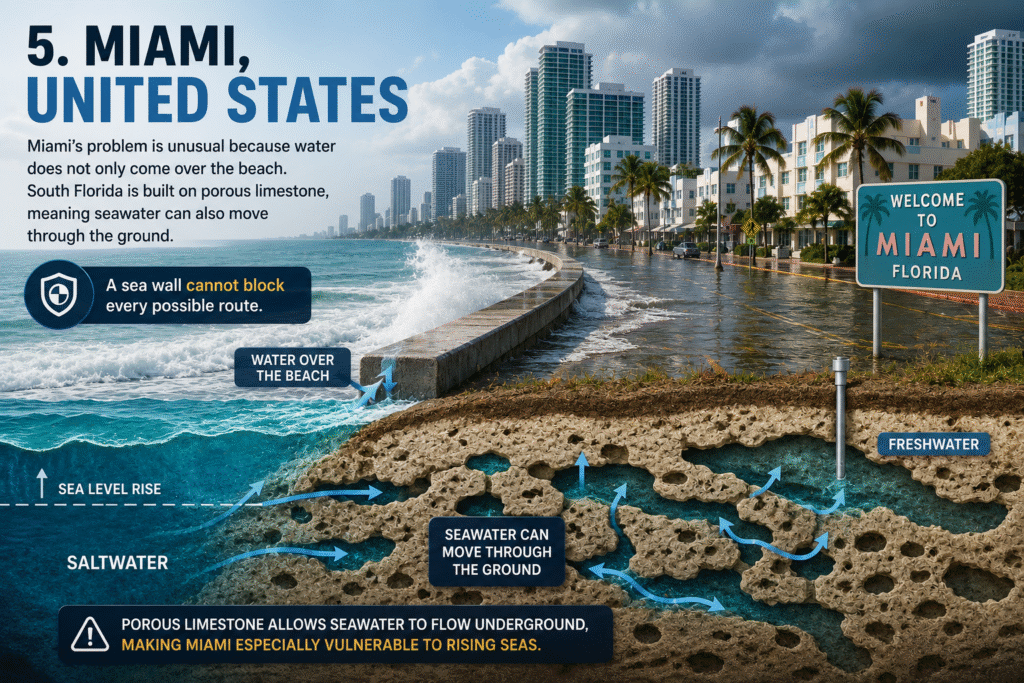
Miami’s problem is unusual because water does not only come over the beach. South Florida is built on porous limestone, meaning seawater can also move through the ground. A sea wall cannot block every possible route.
Some neighbourhoods already experience high-tide flooding even when there is no storm. NOAA says rising seas are making this kind of flooding more frequent across American coastal communities, while seasonal high tides already threaten parts of Miami’s urban landscape.
By 2100, lower parts of Miami and Miami Beach could face regular flooding, higher groundwater and greater hurricane damage. The city may remain standing, but keeping every neighbourhood dry could become extremely expensive.
The first signs may not be dramatic waves washing over skyscrapers. They may be flooded roads, failing drainage systems, higher insurance costs and saltwater moving into places where it did not previously reach.
6. New Orleans, United States
United states is among the countries with best healthcare facilities. New Orleans has lived with water for generations. Much of the metropolitan area depends on levees, pumps and drainage systems, while large parts of the surrounding Louisiana coast are disappearing.
The sea is rising while much of the land is sinking. Local authorities say most of the New Orleans metropolitan region is subsiding relative to sea level. Earlier US Geological Survey measurements also found average subsidence of around five millimetres per year in surveyed leveed areas.
New Orleans has powerful flood-protection systems, but those systems will face greater pressure as water rises and protective wetlands disappear. By 2100, the city could increasingly resemble a protected island surrounded by a vulnerable coastline.
That does not mean New Orleans is certain to disappear. It means its future may depend on constant maintenance, stronger protection and the restoration of surrounding coastal land.
7. Venice, Italy
Venice has always had a close relationship with water. That is part of its beauty, but it is also its greatest weakness.
High-water events already affect low areas such as St Mark’s Square. According to the City of Venice, flooding becomes noticeable there when tide levels rise above approximately 82 centimetres, while higher tides begin affecting other parts of the historic city.
The MOSE barrier system can close during dangerous tides and gives Venice an important layer of protection. However, barriers cannot remove every long-term problem.
As the sea rises, the gates may need to close more often. This could interfere with the lagoon’s natural water exchange, shipping and ecosystems. Venice may still exist in 2100, but protecting its buildings, art and daily life will become harder and more expensive.
8. Alexandria, Egypt
Alexandria sits on Egypt’s Mediterranean coast beside the low-lying Nile Delta. It is a historic city, an important port and home to millions of people.
The World Bank reports that around 45 percent of Alexandria’s population lives below mean sea level, leaving the city highly vulnerable to climate change and coastal flooding.
Rising water can also increase coastal erosion, damage beaches and push salt into land and freshwater systems. Storms would become more dangerous because they would begin from a higher sea level.
Some neighbourhoods and coastal areas could face serious inundation by 2100, especially during extreme weather. Because Alexandria is economically and culturally important, the damage would affect far more than the city itself.
9. Lagos, Nigeria
Lagos is one of Africa’s biggest and fastest-growing urban areas. Much of its development sits beside the Atlantic Ocean, lagoons and wetlands.
The city faces coastal flooding, intense rainfall, blocked drainage, erosion, wetland loss and rapid construction in vulnerable areas. World Bank assessments identify Lagos as highly exposed to river, urban and coastal flooding, with serious risks to homes, infrastructure and economic activity.
Wealthier districts may be able to build barriers or raise structures, but poorer communities often have fewer choices. People living in informal settlements may also have weaker drainage, less secure housing and limited support after a flood.
By 2100, some low coastal districts could be regularly flooded or lost unless planning and protection improve dramatically.
10. Dhaka, Bangladesh
Dhaka is not directly on the open coast, but it sits in one of the world’s largest and lowest river-delta systems. It is surrounded by rivers and already struggles with monsoon flooding and waterlogging.
The city’s elevation ranges from less than one metre to around 14 metres above mean sea level, and its natural canals and waterways are essential for drainage.
Sea-level rise in southern Bangladesh can affect Dhaka indirectly by slowing drainage, driving migration inland and increasing pressure across the delta. Bangladesh is already highly exposed to river, rainwater and coastal flooding, as well as storm surges.
Dhaka may not literally sink beneath the ocean, but parts of its urban region could experience deeper and more frequent floods. Climate migration could also place added pressure on housing, transport, water and public services.
Will These Cities Really Disappear?
Nobody can honestly say that all these cities will be underwater by a specific date. Their futures depend on global emissions, the speed of ice loss, local land subsidence and the choices governments make.
There is also a major difference between a city being exposed and a city being left unprotected. Strong engineering, careful planning and long-term investment can keep low-lying places liveable. Not every city, however, has the same money, institutions or time.
Adaptation can include sea walls, surge barriers, restored mangroves, improved drainage, raised roads and buildings, limits on groundwater pumping and moving development away from the most dangerous areas. In some places, planned relocation may eventually be safer than trying to defend every street.
Final Thoughts
The phrase “underwater by 2100” sounds dramatic, but the real story begins much earlier. A neighbourhood does not need to be permanently covered by the sea to become unliveable. Repeated floods, failing insurance, damaged electricity systems and polluted water may be enough to push families away.
Jakarta, Bangkok, Miami, Lagos and the other cities on this list are not guaranteed to disappear. They are warnings of what can happen when rising water meets sinking land, rapid development and weak protection.
The future is not completely decided. Every reduction in warming can limit future sea-level rise, and every sensible investment can protect lives. The question is not simply which cities will be underwater in 2100. It is how much of them we are willing and able to save before the water reaches the door.