
When people think of a ‘powerful military’, they think of tanks, fighter jets and thousands of soldiers marching in formation. But real military strength is not so simple.
You may have a large army but you cannot easily move supplies. You can have less soldiers but the latest missiles, satellites, submarines, cyber tools and very well trained forces. Money matters, but so do technology, leadership, logistics, geography, industrial capacity, alliances and actual combat readiness.
There is no perfect ranking. Still, the 2026 Global Firepower index gives us a useful picture of conventional military strength by comparing 145 countries across more than 60 factors. Meanwhile, SIPRI reports that global military spending reached $2.887 trillion in 2025. The United States, China and Russia together accounted for 51 percent of that total.
1. United States
The United States remains the world’s strongest military power. Its biggest advantage is not one particular weapon. It is a combination of sophisticated air power, a powerful navy, intelligence networks, modern technology and the ability to move troops and equipment around the world.
It has its aircraft carriers, its overseas bases and partnerships, to give it reach that no other country has today. The US is also continuing its investment in space systems, missile defence, nuclear modernisation and advanced aircraft.
In 2025, US spending is estimated to be $954 billion. It was down from the previous year but still far above the spending of any other single country.
2. Russia
Russia is ranked second in the 2026 Global Firepower index. It remains a major military power because of its enormous nuclear arsenal, long-range missiles, large land forces and extensive defence industry.
The war in Ukraine has revealed serious weaknesses in Russian planning, logistics and equipment. At the same time, it has given Russian forces years of experience in drone warfare, electronic warfare, artillery and long-range strikes. That battlefield experience cannot be ignored, even though it has come at a heavy cost.
Russia spent about $190 billion on its military in 2025. Together, Russia and the United States possess around 83 percent of the world’s stockpiled nuclear warheads.
3. China
China ranks third, but many experts see it as the strongest long-term challenger to the United States. Its armed forces have changed dramatically. China is no longer relying mainly on a massive army. It has invested heavily in modern warships, submarines, aircraft, missiles, drones, satellites, cyber operations and nuclear weapons.
China’s military spending reached an estimated $336 billion in 2025, its 31st consecutive annual increase. Although that is far below US spending, China is mainly preparing for operations close to its own region.This makes it particularly potent in East Asia and the western Pacific. China is competing USA for becoming the most powerful military.
4. India
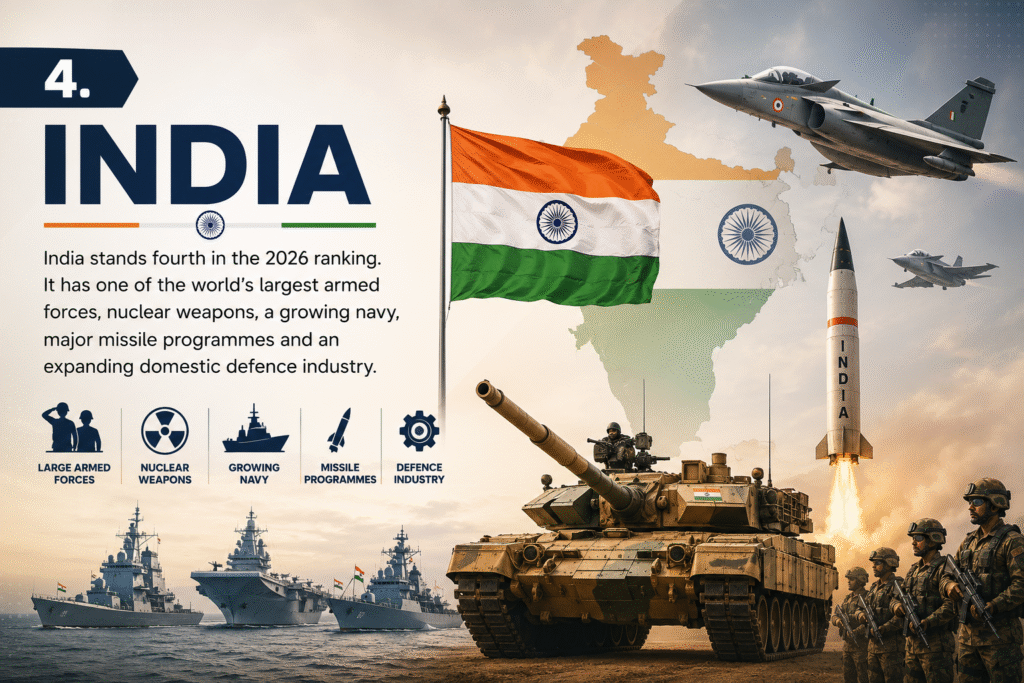
India stands fourth in the 2026 ranking. It has one of the world’s largest armed forces, nuclear weapons, a growing navy, major missile programmes and an expanding domestic defence industry.
Its military must prepare for several challenges at once. India faces a disputed border with China, long-running tension with Pakistan and the need to protect important routes across the Indian Ocean. Because of this, it needs strong land, air and naval forces rather than focusing on only one branch. India has a lot of wealth and has a lot of Billionaires.
In 2025 India was the fifth largest military spender with around $92.1 billion spent on its military.
5. South Korea
South Korea’s fifth-place position may surprise some readers. However, the country faces heavily armed North Korea just across the border, so it has spent decades building a modern and highly prepared military.
It has advanced aircraft, artillery, missiles, armoured vehicles and naval forces. South Korea also has a strong technology sector and a growing defence industry that exports military equipment to other countries.
Its armed forces are mainly designed for a major conflict on the Korean Peninsula rather than distant global operations. Even so, its readiness, technology and conventional firepower place it among the world’s strongest militaries.
6. France
France is ranked sixth and is one of Europe’s strongest all-round military powers. It possesses nuclear weapons, advanced aircraft, submarines, warships and forces that can operate overseas.
One of France’s greatest strengths is independence. It designs and produces much of its own military equipment and does not rely completely on another country for its strategic defence. It also has experience conducting operations outside Europe.
France spent an estimated $68 billion on its military in 2025. Its combination of modern conventional forces, overseas reach and an independent nuclear deterrent gives it influence in excess of its size.
7. Japan
Japan ranks seventh. For decades, its military role was limited by its post-war constitution and strong public support for defensive policies. Rising concerns about China, North Korea and regional security have now encouraged Japan to strengthen its armed forces.
Japan has a highly modern navy and air force, advanced submarines, missile-defence systems and a powerful industrial base. The military budget hit about $62.2 billion in 2025, its largest share of the economy since 1958.
Japan is not a nuclear power but its technology, maritime strength and alliance with the United States make it a major military power in Asia.
8. United Kingdom
The United Kingdom remains one of the world’s most capable military powers, even though its armed forces are smaller than they were in the past.
Britain’s strength comes from quality rather than size. It operates nuclear-powered submarines, advanced aircraft and aircraft carriers. It also possesses nuclear weapons and works closely with the United States and other NATO allies.
The UK spent about $89 billion on its military in 2025. Spending alone does not decide military strength, but Britain’s technology, intelligence partnerships, professional forces and ability to deploy overseas keep it among the global top ten.
9. Türkiye
Türkiye is ranked ninth and has one of NATO’s largest armed forces. Its location between Europe, the Middle East, the Black Sea and the Caucasus gives it major strategic importance.
The Turkish military has considerable operational experience, while the country’s defence industry has expanded quickly. Turkish drones have gained international attention, but Türkiye also produces missiles, armoured vehicles, warships and other military equipment.
Turkey spent some $30 billion on the military in 2025. Its troop strength, geography, domestic weapons production and regional experience make it especially influential in nearby conflicts.
10. Italy
Italy completes the top ten. It is sometimes overlooked because it usually takes a quieter international role than the United States, Russia, France or Türkiye.
However, Italy has a modern air force, capable naval forces, advanced defence companies and an important position in the Mediterranean. It also benefits from NATO membership and close cooperation with other Western militaries.
Italy’s position shows why military power cannot be judged only by army size or dramatic headlines. Modern equipment, trained personnel, industrial support and strong allies can be just as important as large numbers of soldiers.
Other Countries Worth Mentioning
Several powerful countries sit just outside the top ten. Germany ranked 12th and boosted military spending to about $114 billion in 2025, the most of any European NATO member.Pakistan ranks 14th and remains a major regional power with nuclear weapons. Israel ranks 15th but has advanced military technology, strong intelligence capabilities and extensive combat experience.
Australia, Iran, Saudi Arabia, Ukraine and North Korea are also strong in particular areas. Some have advanced technology, some possess large missile forces, while others have valuable battlefield experience. Their importance depends heavily on the type and location of a possible conflict.
For example, a country might not have the ability to fight on the other side of the world, but it could still be extremely difficult to defeat inside its own region. Geography, defensive positions, local supply routes and knowledge of the terrain can change everything.
Final Thoughts
Overall, the United States still has the most powerful military. It combines the world’s largest defence budget with global reach, advanced technology, air and naval power, intelligence capabilities and strong alliances.
Russia and China are its closest major rivals, but their strengths are different. Russia relies heavily on nuclear weapons, missiles, land forces and combat experience. China’s power comes from rapid modernization, economic strength and its growing position in the Asia-Pacific region.
Below them, India, South Korea, France, Japan and the United Kingdom each represent a different kind of military power. Some depend on size, while others rely more on technology, readiness, nuclear deterrence or alliances.
The main lesson is simple: military strength is never just a count of tanks, ships or soldiers. A truly powerful military must train its people, maintain its equipment, protect supply lines, gather reliable intelligence, replace losses and make good decisions under pressure. A great thing would be if big countries spend more on healthcare.
Numbers may look impressive on paper, but real power depends on how effectively a country can use what it has. A thousand tanks are not very useful without fuel, spare parts, trained crews and proper planning. In the same way, expensive aircraft mean little if they cannot be maintained or protected. This is why military rankings should always be treated as general guides rather than final answers. Wars are unpredictable, and real performance can be very different from what statistics suggest. Technology and weapons matter, but leadership, preparation, morale and strategy often decide what happens when a military is placed under real pressure.