
Introduction
If someone had told us ten years ago that algorithms would help doctors diagnose cancer, predict heart attacks, and even assist in surgery, it would have sounded dramatic, maybe even unsettling.
But here we are in 2026, and artificial intelligence isn’t some flashy future concept anymore. It’s quietly sitting in hospital systems, running in the background of health apps, scanning medical images, and helping doctors make faster decisions.
What’s interesting is that the biggest transformation isn’t dramatic. It’s subtle. It’s in the small improvements that add up.
And most patients don’t even realize it’s happening.
Healthcare Is Becoming Predictive, Not Just Reactive
Medicine has been reactive for most of modern history. You feel sick. You visit a clinic. Tests are done. Treatment begins. AI is changing that rhythm.
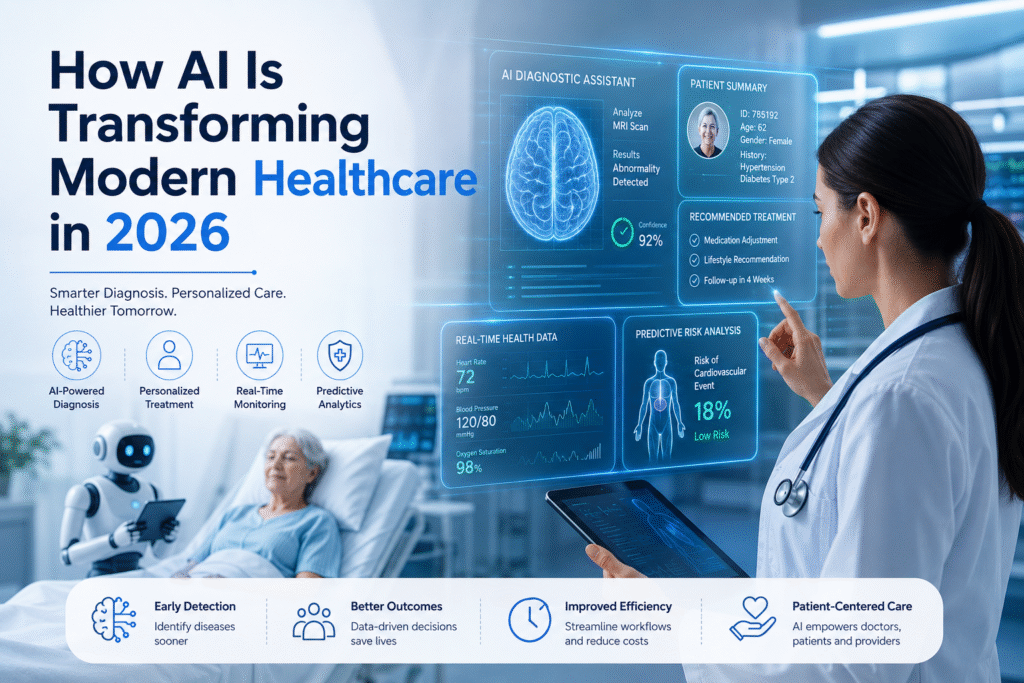
Today, hospitals use predictive models that analyze years of patient data, blood reports, past diagnoses, medications, lifestyle patterns and identify risks before symptoms show up. Instead of waiting for a heart problem to surface, systems can now flag high-risk patients months earlier.
That early warning makes a difference.
Doctors aren’t guessing in the dark anymore. They’re walking into appointments with deeper context. It doesn’t replace clinical judgment, it sharpens it.
And prevention is always cheaper, safer, and less painful than emergency care.
Diagnoses Are Faster (and Sometimes More Accurate)
Radiology has probably seen one of the most visible AI shifts.
When a radiologist reviews hundreds of scans in a day, fatigue is real. Tiny abnormalities can be missed. AI doesn’t get tired. It doesn’t rush.
Organizations like Google Health have developed imaging models that can detect early-stage cancers with impressive accuracy. These systems analyze patterns at a microscopic level, patterns the human eye might overlook.
What’s important is this: AI is not replacing radiologists. In most hospitals, it acts as a second reviewer. A second opinion that works in seconds. In emergency cases stroke, internal bleeding, lung complications, time matters. If AI reduces reporting time even by minutes, outcomes improve.
It’s not dramatic. It’s practical.
Personalized Treatment Is Becoming Real
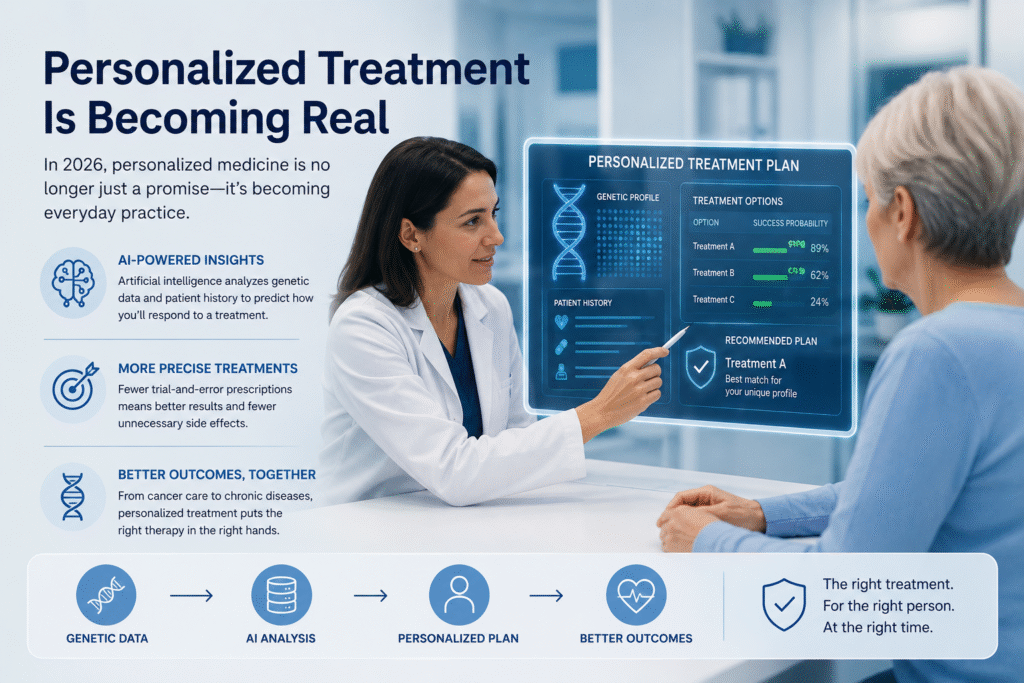
For years, “personalized medicine” sounded like marketing language. In 2026, it’s slowly becoming real practice.
Artificial intelligence (AI) systems can now forecast a patient’s potential response to a given drug by analysing genetic data and patient history. That means fewer trial-and-error prescriptions.
Cancer treatment, especially is benefiting. Tumor genetics can be analyzed quickly, and therapy options can be ranked based on probability of success.
That reduces unnecessary side effects and improves recovery chances.
Medicine is moving away from averages.
It’s moving toward individuals.
Your Watch Might Be Smarter Than You Think
A lot of health transformation isn’t happening in hospitals, it’s happening on wrists.
Devices like the Apple Watch continuously monitor heart rhythms, oxygen levels, and sleep cycles. By 2026, these wearables will be able to do more than just count steps. They identify erratic heartbeats and notify users before they ever become aware that something is amiss.
Instead of quarterly checkups being the only data point, doctors can review continuous trends.
That changes conversations.
It turns isolated snapshots into ongoing stories.
Telemedicine Feels More Structured Now
Video consultations are no longer chaotic or rushed.
On platforms like Teladoc Health, there’s usually a short step before the call where you answer a few questions about what you’re feeling. That information gets arranged in a simple summary, so when the doctor connects, they already have a basic idea of what’s going on. It saves time and makes the conversation feel more natural. The system collects structured input duration, intensity, medical history and organizes it neatly.
That means less time repeating information. More time actually discussing solutions.
For rural communities or patients who struggle with mobility, this accessibility is significant. It’s not just convenient. It’s expanded reach.
From Reactive to Predictive Care
For decades, healthcare has been reactive. You feel symptoms, You visit a doctor, You get tested, You receive treatment.
AI is gradually shifting that model toward prediction and prevention.
Machine learning systems can now analyze years of patient data, lab results, medical history, imaging scans, genetic markers, lifestyle patterns and identify risks long before symptoms appear. Hospitals using predictive analytics can flag patients at risk of heart disease, diabetes complications, or stroke months in advance.
This doesn’t replace physicians. It supports them. Instead of waiting for illness to escalate, clinicians can intervene early with personalized treatment plans.
That shift alone is redefining what “modern medicine” means.
Drug Development Is Moving Faster
Developing new medicine used to take over a decade. AI is compressing early research timelines by analyzing millions of chemical combinations in simulations.
Instead of physically testing everything in a lab, researchers can eliminate weak candidates digitally first.
That doesn’t remove clinical trials or safety checks that remain critical but it accelerates the starting point.
Faster research means faster hope for patients waiting for treatment breakthroughs.
Doctors Are Spending Less Time on Screens
Ironically, one of AI’s biggest contributions is reducing digital burden.
Physicians have long complained about electronic health records consuming more time than patient interaction. AI-powered transcription systems now convert conversations into structured medical notes automatically.
No more typing for hours after the clinic closes.
No more fragmented documentation.
When doctors spend less time clicking boxes, they spend more time listening.
That’s not just efficiency. That’s quality of care.
What About the Risks?
Of course, it’s not perfect.
Data privacy hasn’t gone away as a concern if anything, it feels bigger now. Medical records aren’t just numbers on a screen; they contain some of the most personal details about a person’s life. That’s why hospitals are pouring serious investment into cybersecurity. The problem is, digital threats don’t stand still. As technology improves, so do the tactics used to exploit it.
It is predicated on responsibility.
The Human Role Will Always Exist
Despite all of this technology, one thing hasn’t changed:
People still want human care.
They want reassurance. Eye contact. Empathy.
AI can process massive data sets in seconds, but it cannot replace the emotional intelligence of a skilled physician or nurse.
The most successful healthcare systems in 2026 understand this balance. AI handles analysis. Humans handle connection.
And that division makes sense.
So What’s Really Changing?
If we step back, the transformation isn’t about robots taking over hospitals.
It’s about reducing friction.
Fewer missed diagnoses
Earlier detection
Smarter prescriptions
Faster research
Less paperwork
Better access
The system isn’t becoming colder. In many ways, it’s becoming more focused. Because when machines handle repetitive analysis, healthcare professionals can concentrate on what they were trained to do to care for people.