
The “Just Selling Products” Mindset
If you’ve spent even a little time in eCommerce, you’ve probably noticed two very different types of sellers.
On one side, there are people chasing quick wins, launching products, running ads, and trying to squeeze profit out of trends before they die. On the other side, you’ve got brands the ones people actually remember. They move differently. They don’t just sell products, they build something people remember.
The real question is: which approach actually works better today?
Let’s break it down in a real, no-BS way.
Why People Choose This Approach
The “Just Selling Products” Mindset
This is usually where most people start and honestly, it’s a pretty natural way to begin.
You find a product that’s already selling. Maybe it’s trending on TikTok or doing well on Amazon. You set up a quick store, run some ads, and hope to catch the wave before it crashes.
It’s fast. It’s simple. And sometimes… It works.
Why People Choose This Approach
Low upfront effort
No need for deep strategy
Quick testing of multiple products
Potential for fast cash
For beginners, this feels like the easiest entry point into eCommerce.
But here’s where things start to crack.
The Hidden Problems
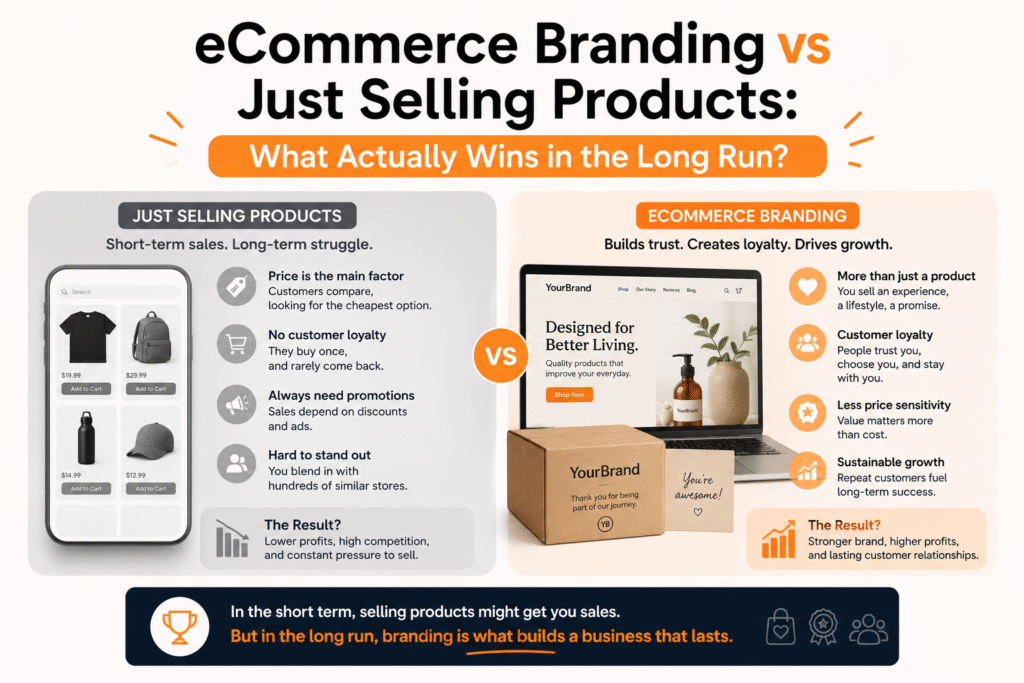
Selling random products without branding is like building a house on rented land. You don’t own anything real.
No customer loyalty – People buy once and disappear
Ad dependency – The moment you stop ads, sales drop to zero
High competition – Anyone can copy your product overnight
No differentiation – Your store looks like 100 others
You’re not building an asset, you’re running a temporary hustle.
And in 2026, that hustle is getting harder.
Ad costs are rising. Customers are smarter. And trust matters more than ever.
What eCommerce Branding Really Means
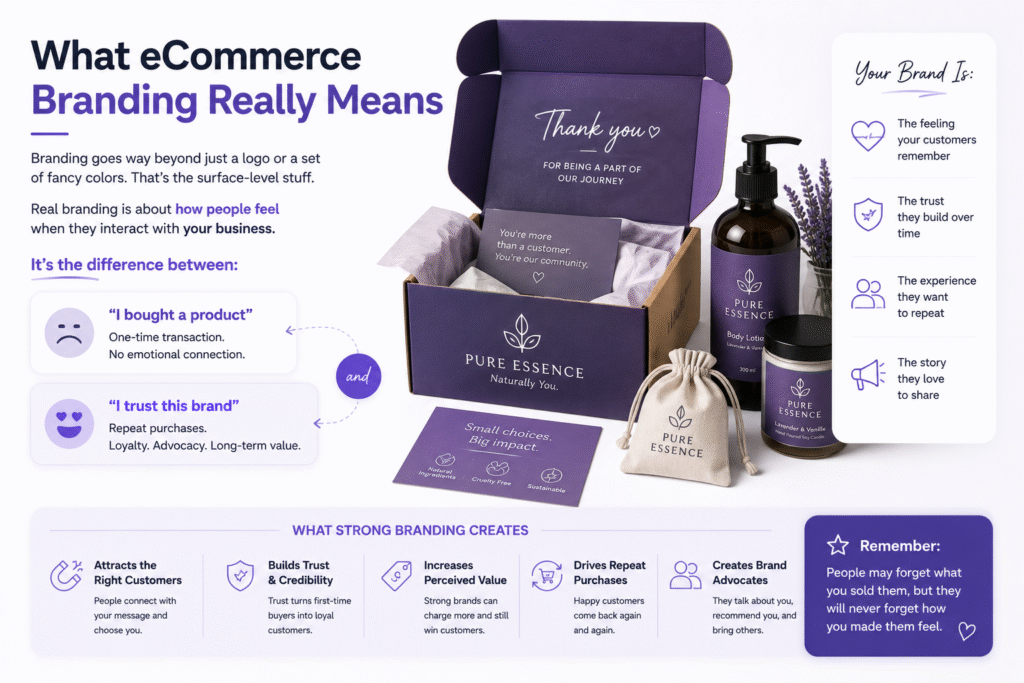
Branding goes way beyond just a logo or a set of fancy colors. That’s the surface-level stuff.
Real branding is about how people feel when they interact with your business.
It’s the difference between:
“I bought a product”
and
“I trust this brand”
That second one is where the money is.
A Real Brand Has:
A Real Brand Has:
A clear sense of who it’s meant for and what it actually stands for.
Consistent messaging
A recognizable voice
A reason for people to come back
Think about it when someone buys from a strong brand, they’re not just buying the product by seeing the amount of traffic.
They’re buying:
Trust
Experience
Story
Reliability
And that changes everything.
Why Branding Is Winning Today
Let’s be real the eCommerce game has matured.
Back in the early dropshipping days, you could throw up a basic store, run Facebook ads, and print money. That era is mostly gone.
Today, customers ask questions like:
“Is this legit?”
“Why should I buy from you?”
“Can I trust this store?”
Branding answers all of these without you having to say a word.
1. Trust = Higher Conversion Rates
A branded store doesn’t look like a scam.
When your site feels polished, consistent, and professional, people are more comfortable spending money.
That alone can double your conversion rate compared to a generic store.
2. Branding Lowers Your Ad Costs
This is something most beginners don’t realize.
If people recognize your brand:
They click more
They engage more
They convert faster
Platforms reward that.
So instead of fighting high CPMs, your brand actually makes your ads cheaper over time.
3. Repeat Customers = Real Profit
Here’s a truth most “product sellers” ignore:
The real money in eCommerce is not the first sale. It’s the second, third, and fourth.
Without branding:
You’re constantly chasing new customers
Your profit margins stay thin
With branding:
Customers come back
You build email lists
You increase lifetime value
That’s how businesses scale.
4. You Become Copy-Proof
If you’re just selling products, you’re always replaceable.
Someone can:
Find your supplier
Undercut your price
Copy your ads
But they can’t copy your brand identity, your voice, or your connection with customers.
That’s your moat.
The Reality: Branding Takes More Effort
Now let’s not pretend branding is easy.
It’s slower. It requires thinking. And you won’t always see instant results.
What Makes Branding Harder?
What Makes Branding Harder?
You need a clear niche
You need consistency across everything
You need better content
You need patience
This is why many people avoid it.
They want quick wins, not long-term systems.
But here’s the trade-off:
Short-term sellers chase money
Brands attract money
When “Just Selling Products” Still Makes Sense
To be fair, selling products without heavy branding isn’t useless.
It still has a place if you use it correctly.
It Works Well For:
It Works Well For:
Testing product ideas
Learning ads and funnels
Generating initial cash flow
Think of it like a lab.
You experiment, you learn what works, and then…
You build a brand around the winners.
The mistake people make is staying stuck in the testing phase forever.
How to Transition from Selling to Branding
This is where things get interesting.
You don’t need to start with a perfect brand. You evolve into one.
Step 1: Pick a Direction
Stop selling random products.
Focus on:
One niche
One audience
One problem
Clarity is the foundation of branding.
Step 2: Build a Story
Why does your brand exist?
Even a simple angle works:
Affordable fitness for beginners
Skincare for sensitive skin
Minimalist home essentials
You don’t need a dramatic story just a clear one.
Step 3: Fix Your Store Experience
Your store should feel intentional.
That means:
Clean design
Consistent colors and fonts
Real product descriptions (not copy-paste junk)
Your website is your digital storefront. If it feels off, people leave.
Step 4: Create Content, Not Just Ads
Brands don’t rely only on ads.
They show up where people already are social media. Not just to sell, but to share things that actually help or interest their audience. Over time, they start conversations, reply to comments, and build a small community around what they do.
That’s when something shifts. People don’t just see a store anymore they start recognizing the brand.
Step 5: Focus on Retention
Don’t see the first sale as the finish lineit’s just where things begin. What really counts is giving people a solid reason to come back. Keep in touch with them, offer something useful beyond just selling, and make their overall experience so smooth and reliable that coming back to you feels like the obvious choice.
Email marketing
SMS campaigns
Loyalty offers
Turn buyers into repeat customers.
That’s where the game changes.
The Biggest Misconception
A lot of people think:
“Branding is only for big companies.”
That’s completely wrong.
In fact, smaller eCommerce stores need branding more.
Why?
Because you don’t have:
Massive budgets
Big teams
Established trust
Branding is your shortcut to competing with bigger players.
So, Which One Should You Choose?
Here’s the honest answer:
If you want quick cash, sell products.
If you want a real business, build a brand.
But the smartest approach?
Do both strategically.
Start by testing products. Find something that works.
Then stop acting like a reseller…
…and start building something people actually care about.
Final Thoughts
eCommerce is no longer about who finds the product first.
It’s about who builds the strongest connection with customers.
Anyone can sell a product. But not everyone can build a brand that people trust, remember, and come back to.