
If you’ve been around eCommerce for even a short time, you’ve probably noticed something: things are moving much faster now than they did a few years ago.
What used to take weeks now takes days.
What used to need a full team can sometimes be done by one person with the right tools.
And a big reason behind that shift is AI.
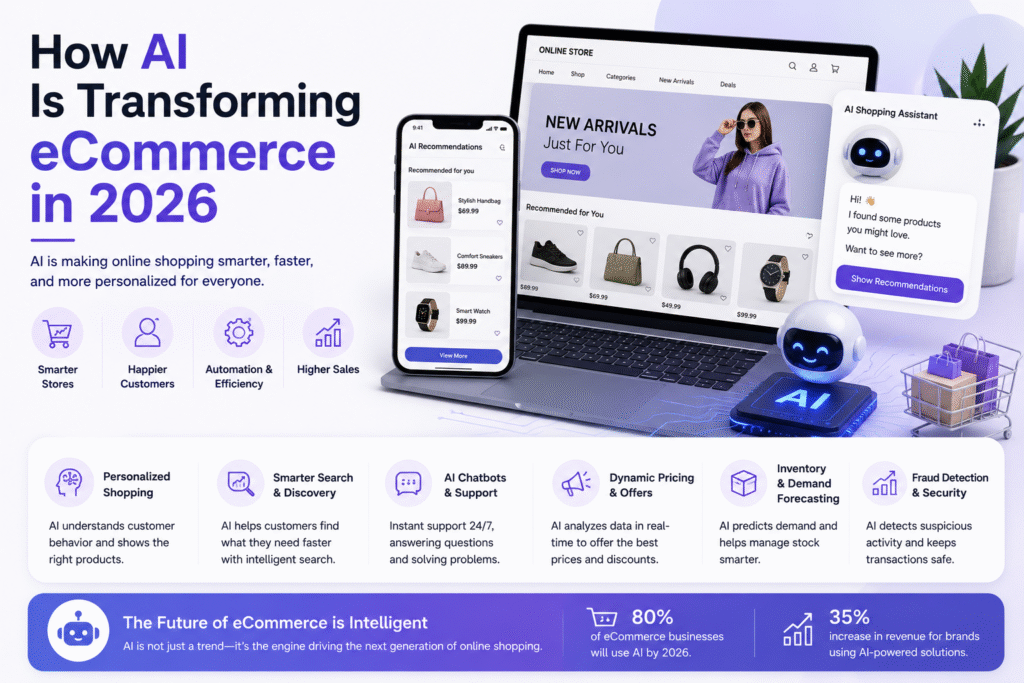
In 2026, artificial intelligence is not some future concept that only massive companies are experimenting with. It’s already part of how online businesses run every day. From product recommendations and customer support to pricing, content, and inventory planning, AI is quietly changing how eCommerce works in the background.
The interesting part is this: it’s not only helping big brands.
Small online stores, solo founders, dropshippers, Amazon sellers, Shopify store owners, and direct-to-consumer brands are all using AI in different ways. Some use it to save time. Some use it to improve customer experience. Others use it because the competition is getting stronger and they simply can’t afford to work the old way anymore.
Personalized Shopping Experiences Are Becoming the New Standard
Many online retailers used to serve every customer the same way a few years ago. Everyone saw the same homepage, the same product collections, the same offers, and the same recommendations. That approach still exists in some places, but it’s becoming less effective.
This feels small on the surface, but it changes the buying experience a lot.
Customers are more likely to stay on a site when it feels relevant to them. They are more likely to click when the products make sense. And they are more likely to buy when they feel like the store understands what they’re looking for.
In a crowded market, relevance matters.
Product Recommendations Are Smarter Now
Almost every online shopper has seen a “you may also like” section. But in 2026, AI has made those sections much smarter than before.
Old recommendation systems were basic. Sometimes they worked. Sometimes they felt random.
Now AI looks deeper.
Instead of showing another random shirt because someone looked at a shirt, AI might suggest:
a bundle that increases order value
a similar item in a better-selling color
a premium version with stronger conversion data
an accessory that often gets bought with that exact product
This is important because good recommendations don’t just help customers. They also increase average order value in a way that doesn’t feel forced.
That’s why AI-driven product discovery is becoming one of the most profitable parts of modern eCommerce.
Customer Support Is Becoming Faster Without Feeling Useless
A customer might ask:
“Where is my order?”
“Will you deliver to my city?”
“Which size should I buy?”
“Can I return this if it doesn’t fit?”
And the AI can often respond accurately, quickly, and without making the experience frustrating.
For store owners, that’s a huge win.
If a customer gets a quick answer while they are still in buying mode, the chances of conversion go up immediately.
So in 2026, AI support isn’t just about saving customer service costs. It’s also helping recover revenue that would otherwise be lost.
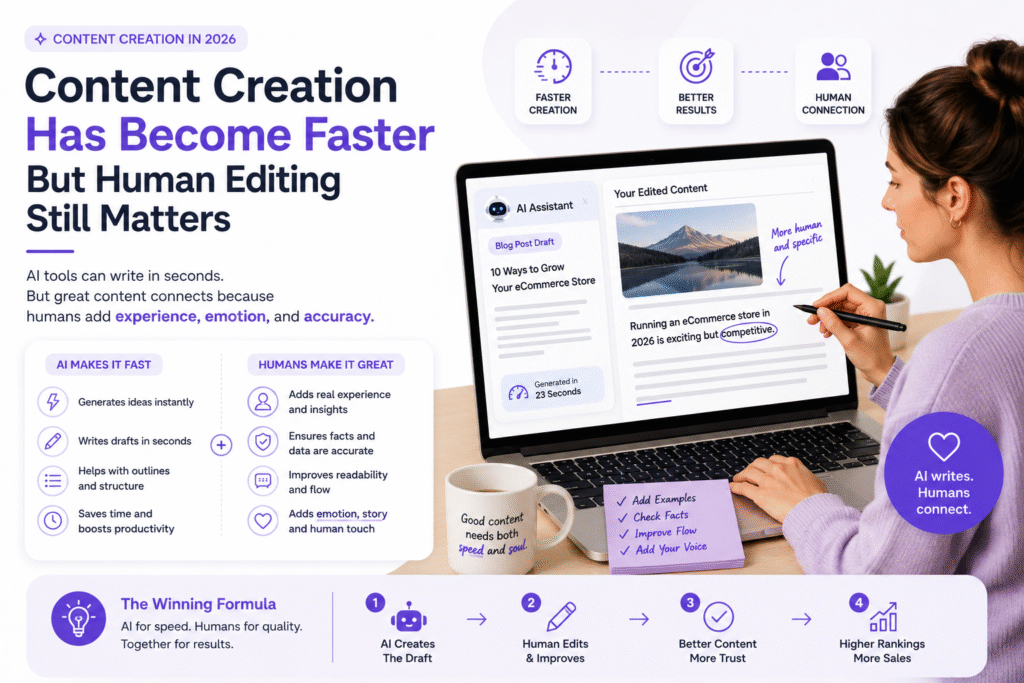
Content Creation Has Become Faster But Human Editing Still Matters
Content is still a major part of eCommerce, and that hasn’t changed.
Online stores need product descriptions, category pages, blog posts, email campaigns, ads, FAQs, and social media content. The demand is huge, especially for stores that want organic traffic and better conversion rates.
AI has made this easier.
Just because AI can generate content quickly doesn’t mean the raw output is always good enough.
Generic content still feels generic. Over-optimized content still sounds fake. And customers can often sense when something feels mass-produced.
The brands getting the best results are not just publishing whatever the tool gives them. They use AI as a starting point, then shape the content with real brand tone, real product understanding, and real customer intent.
That’s especially important for SEO too.
As someone already working in SEO, you know this well: traffic alone is not enough. Content has to rank, match intent, and actually convert.
AI helps with speed. Human judgment still makes the difference.
Pricing Decisions Are Becoming More Intelligent
Pricing is one of those areas where many eCommerce businesses still rely on guesswork and ecommerce branding is also very important.
They check competitors, make a few changes, maybe run discounts, and hope for the best.
In 2026, AI is changing that.
Instead of looking at pricing as a static decision, AI allows businesses to treat it as a living strategy. It can track changes in demand, monitor competitor pricing, identify slow-moving inventory, and even suggest when a discount might hurt more than help.
For example, if a product is selling fast and inventory is getting low, AI may recommend holding the price or slightly increasing it. If another product is getting traffic but not converting, the system may flag pricing as a possible issue. If competitors suddenly start discounting, the business can respond faster.
This doesn’t mean every store needs to constantly change prices every hour.
But it does mean pricing can become more informed instead of emotional.
And in eCommerce, better pricing decisions can protect profit margins more than most people realize.
Inventory Management Is Getting Less Stressful
And in 2026, that’s becoming a real competitive edge.
Visual Search and Voice Shopping Are Becoming More Useful
People don’t always want to type exact product names on which they can trust.
Sometimes they see a product in a photo. Sometimes they only know what it looks like. Sometimes they just want to say what they need out loud.
That’s why visual search and voice commerce are becoming more practical now.
With visual search, shoppers can upload an image and find similar products. This is especially useful in fashion, furniture, home décor, beauty, and accessories. Instead of describing a product badly, they can simply show it.
Voice shopping is improving too.
Fraud Detection and Risk Prevention Are Getting Smarter
Some of the most valuable changes are happening behind the scenes.
Fraud is still a big problem in eCommerce, and honestly, it’s not going away anytime soon.
As online stores grow, the risks also grow. Things like fake orders, chargebacks, stolen card payments, refund abuse, and even bot activity are becoming more common.
This is another area where AI is making a real difference in 2026.
Instead of only depending on old rule-based systems, AI can catch unusual patterns much faster.
The Real Future Is Not AI Alone It’s AI Plus Human Strategy
There’s a common fear that AI is replacing everything.
In reality, what it’s really replacing is slow work, repetitive tasks, weak forecasting, and inefficient systems.
The strongest eCommerce brands in 2026 are not the ones handing everything over to AI blindly.
They’re the ones using AI where it actually makes sense.
Humans still build trust.
Humans still understand emotion.
Humans still shape brand voices.
Humans still make the final judgment calls.
AI just helps them do those things faster and with better data.
That’s the real shift.
Final Thoughts
AI is changing eCommerce in 2026 in a lot of different ways.
Some changes are very easy to notice.
But not everything is visible on the surface.
And when all of these improvements come together, they’re changing the way eCommerce businesses work from top to bottom.
The good news is that this isn’t only for enterprise brands anymore. Smaller stores can now access tools that were once out of reach. That means the future of eCommerce may belong less to the biggest players and more to the smartest ones.
Because in the end, AI doesn’t automatically make a business successful.
It just gives businesses better tools. And the brands that know how to use those tools without losing the human touch are the ones most likely to win in 2026.