
Introduction
Pricing looks easy… until you actually have to do it.
At the start, most people think it’s just numbers. You take your cost, add some profit, and that’s your price. Done.
But once your store is live, things don’t go as planned.
You might get traffic but no sales. Or sales, but very little profit. Sometimes you lower the price thinking it’ll help… and nothing really changes.
That’s when it clicks, pricing isn’t just math. It’s behavior.
People don’t buy based on logic alone. People buy things based on how they feel about them.. And your price plays a big role in that feeling.
Cost-Based Pricing Foundation
First things first you have to make sure you’re not losing money.
Product cost, delivery, packaging, ads… it all adds up. So yeah, starting with cost-based pricing makes sense. It protects you from selling at a loss.
But here’s where people get stuck.
They treat that number like it’s final. Like it can’t be changed.
The market doesn’t care about your costs though. Customers are comparing you with other options, not your spreadsheet.
So use cost as a reference point. Not a rule you can’t break.
What Others Are Charging (And Why It Matters)
Before setting your price, just take a few minutes and look around.
Search your product. Check a few competitors. See the range and AI can really help.
You’ll usually notice something interesting: prices are rarely identical. There’s always variation.
Some brands charge more and still sell well. Others go cheaper and struggle.
Why?
Because price alone isn’t the deciding factor.
Let’s say two stores are selling the same item. One looks basic, the other looks more polished, better images, clearer descriptions, maybe some reviews.
Most people will trust the second one… even if it’s slightly more expensive.
So instead of thinking, “I need to be cheaper,” think, “How can I justify my price?”
That’s a much better game to play.
The Weird Power of Small Numbers
This part feels minor, but it actually makes a difference.
$30 vs $29.99
$50 vs $47
Technically, there’s almost no difference. But psychologically, there is.
People read from left to right. So $29.99 feels closer to $20 than $30, even though it’s basically $30.
It’s not rational, but buying decisions rarely are.
Another thing: clean pricing works better.
If your page looks messy or confusing, even a good price feels risky and the loyalty suffers. But if everything looks clear and simple, people are more comfortable moving forward.
Sometimes, the problem isn’t really the price. It’s how it’s presented.
Value Changes Everything
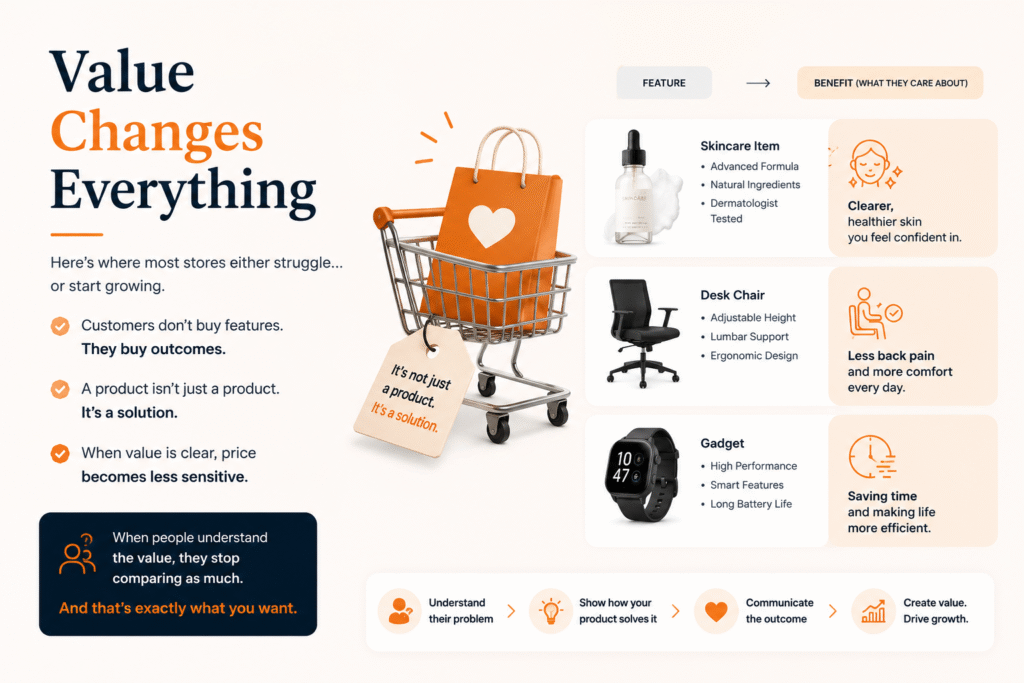
Here’s where most stores either struggle… or start growing.
Ask yourself honestly why would someone want to buy this?
Not the features, the actual benefit.
Because customers don’t really care about features. They care about outcomes.
A product isn’t just a product. It’s a solution.
A skincare item → clearer skin
A desk chair → less back pain
A gadget → saving time
When you communicate that clearly, price becomes less sensitive.
You’ll notice something interesting too when people understand the value, they stop comparing as much.
And that’s exactly what you want.
Bundles: Quietly Increasing Your Revenue
Selling one item is fine.
But giving options like “buy more and save more” changes how people think.
Instead of asking, “Should I buy this?” They begin wondering, “Which option is the best one for me?”
That’s a completely different mindset.
For example:
1 item for $20
2 for $35
3 for $50
Now the single product feels like the least attractive option.
And even if someone originally planned to buy just one, they often upgrade.
You didn’t force them. You just presented a better deal.
Too Many Choices = No Choice
It sounds strange, but giving people too many options can actually reduce sales.
When everything looks similar, people hesitate.
That’s why simple pricing tiers work so well.
Three options is usually enough:
Basic
Standard
Premium
The majority will with the Standard option. It feels safe.
Not too cheap, not too expensive.
If you structure it right, that middle option can also be your most profitable one which is kind of the whole point.
Discounts… Use Them Carefully
Discounts work. No doubt.
You drop the price, sales go up. Simple.
But if you keep doing it, people start noticing a pattern.
They wait.
Instead of buying now, they think, “It’ll go on sale again.”
And just like that, your pricing loses its strength.
A better way is to use discounts occasionally, not constantly.
Or even better make the offer feel like a bonus instead of a discount.
Free shipping, extra quantity, small add-ons… these sometimes convert better than just cutting the price.
Pricing Isn’t Something You Set Once
A lot of store owners set their price and never touch it again.
That’s a mistake.
Pricing should evolve based on what’s happening.
If you’re getting traffic but no sales, then something isn’t working right.It could be the price, or it could be how the value is presented.
If a product is selling too easily, you might actually be underpricing it.
Testing helps here.
Small changes are enough. You don’t need to jump from $20 to $40. Even a $2–$3 difference can tell you a lot.
And over time, you start understanding your audience better.
It’s not only about the price, it’s about how you present it.
Positioning Through Pricing
Here are some things people don’t notice at first.
You’re not just setting a price. You’re positioning your product.
Cheap price → budget option
Higher price → premium feel
Neither is wrong. It just depends on what you’re trying to build.
But you can’t mix both.
If your branding looks premium but your price is too low, it creates confusion. Same the other way around.
Everything needs to align your visuals, your messaging, your offer, and your price.
Final Thoughts
There’s no perfect pricing formula.
Anyone who tells you there is… probably hasn’t tested enough.
What works is paying attention, adjusting when needed, and understanding your customers a little better over time.
Because at the end of the day, people don’t buy the cheapest product.
They buy the one that feels right. And your pricing plays a big role in creating that feeling.