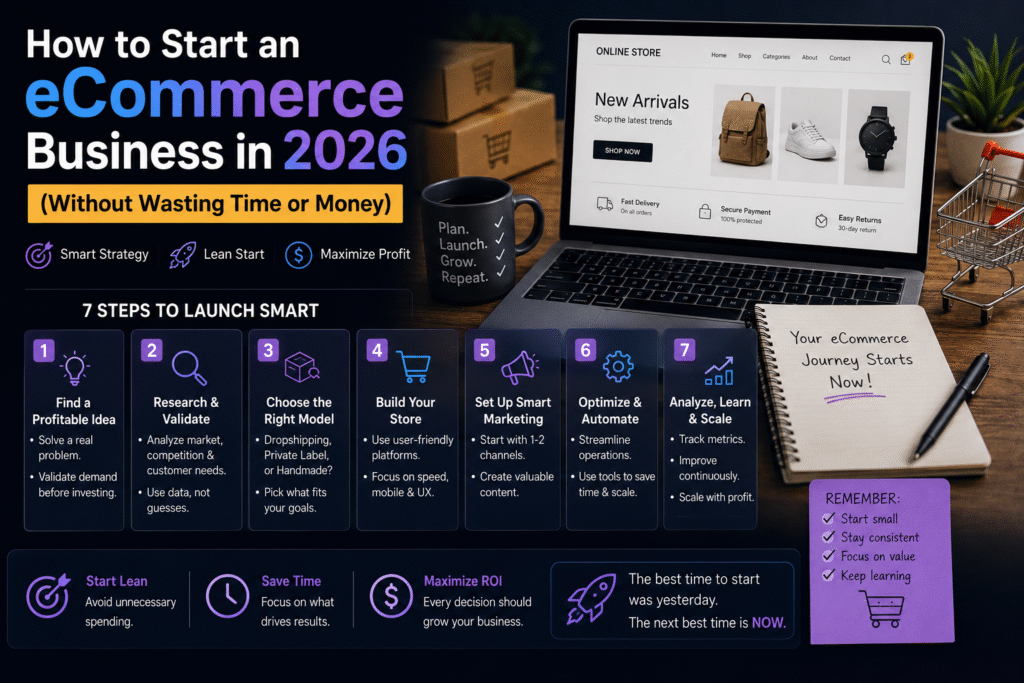

If you’ve been thinking about starting an eCommerce business in 2026, you’re definitely not too late.
A lot of people assume online selling is already overcrowded and that only big brands can win now. Honestly, that’s not true. Yes, competition is stronger than it was a few years ago, but people are also buying more online than ever before. The difference is that in 2026, random stores with random products usually don’t last. The businesses that grow are the ones that feel trustworthy, solve a real problem, and actually understand their customers.
That’s the part many beginners miss.
Starting an eCommerce business today is not hard from a technical point of view. You can set up a store in a weekend if you want. The hard part is choosing the right product, presenting it well, and getting the right people to notice it.
If you want to do it properly, this guide will help you understand what actually matters before you spend money on ads, products, or a fancy website.
First, understand what kind of eCommerce business you want
A lot of beginners jump straight into store design without thinking about the model behind the business. That usually leads to confusion later.
In 2026, the most common options are still:
- Dropshipping – You sell products, but a supplier handles inventory and shipping.
- Print on demand – You sell custom products like shirts, mugs, tote bags, or phone covers after someone places an order.
- Private label – You sell your own branded version of a product.
- Wholesale or reselling – You buy stock in bulk and sell it at a profit.
- Handmade or custom products – Great if you already create something unique.
Don’t try to sell everything
This is one of the biggest mistakes new store owners make.
They build a general store with gadgets, kitchen tools, pet items, beauty products, random accessories… basically a bit of everything. It might feel smart because it gives you more options, but most of the time it makes your store look weak and forgettable.
In 2026, niche stores still make more sense.
A niche store is easier to brand, easier to market, and much easier to rank if you care about SEO. When people land on a store that clearly focuses on one category, it feels more trustworthy.
For example, instead of creating a store that sells “home products,” you could narrow it down to:
- smart desk accessories for remote workers
- eco-friendly kitchen essentials
- travel gear for pet owners
- minimalist bedroom organizers
- skincare tools for men
That’s much stronger.
When choosing a niche, don’t only think about what’s trending for a week. Ask yourself a few simple questions:
- Are people already spending money in this category for bringing traffic?
- Can I solve a specific problem?
- Is there enough room for profit after product cost and shipping?
- Can I create content around this niche later?
If the answer is yes, you’re already in a much better position than most beginners.
Product research matters more than store design
People love spending hours picking themes, logos, and colors. But the truth is, a beautiful store won’t save a weak product.
A solid product with decent presentation usually beats a pretty website selling something nobody really wants.
The best eCommerce products in 2026 usually have at least one strong angle:
- they solve a frustrating problem
- they save time
- they make life easier
- they have a visible “before and after” effect
- they appeal to a passionate audience
- they look good in short-form video content
- Best pricing strategy is also important
That last point matters more now than ever.
If a product can be shown in a quick video and make someone instantly understand its value, it has a much better chance of selling on platforms like Instagram Reels, TikTok, and YouTube Shorts.
Before you commit to any product, check:
- competitor stores
- marketplace reviews
- shipping times
- product quality complaints
- price expectations
- whether the product has repeat-buy potential
A product can look amazing in an ad and still fail because delivery takes too long or customer expectations don’t match reality.
Your brand matters more now than it used to
A few years ago, people got away with generic stores and copy-paste product pages. In 2026, that’s much harder.
Customers are more cautious. They’ve seen too many low-quality stores. They can spot a lazy setup quickly.
That means branding is no longer optional.
You don’t need a huge corporate brand, but your store should at least feel intentional.
That includes:
- a clean, simple name
- a logo that doesn’t look random
- consistent fonts and colors
- product photos that match the style of your store
- descriptions written like a real person wrote them
- a clear reason why someone should buy from you instead of a marketplace
The goal is simple: when someone lands on your website, it should not feel like a temporary store made overnight.
It should feel like a real business.
Pick the right platform and keep it simple
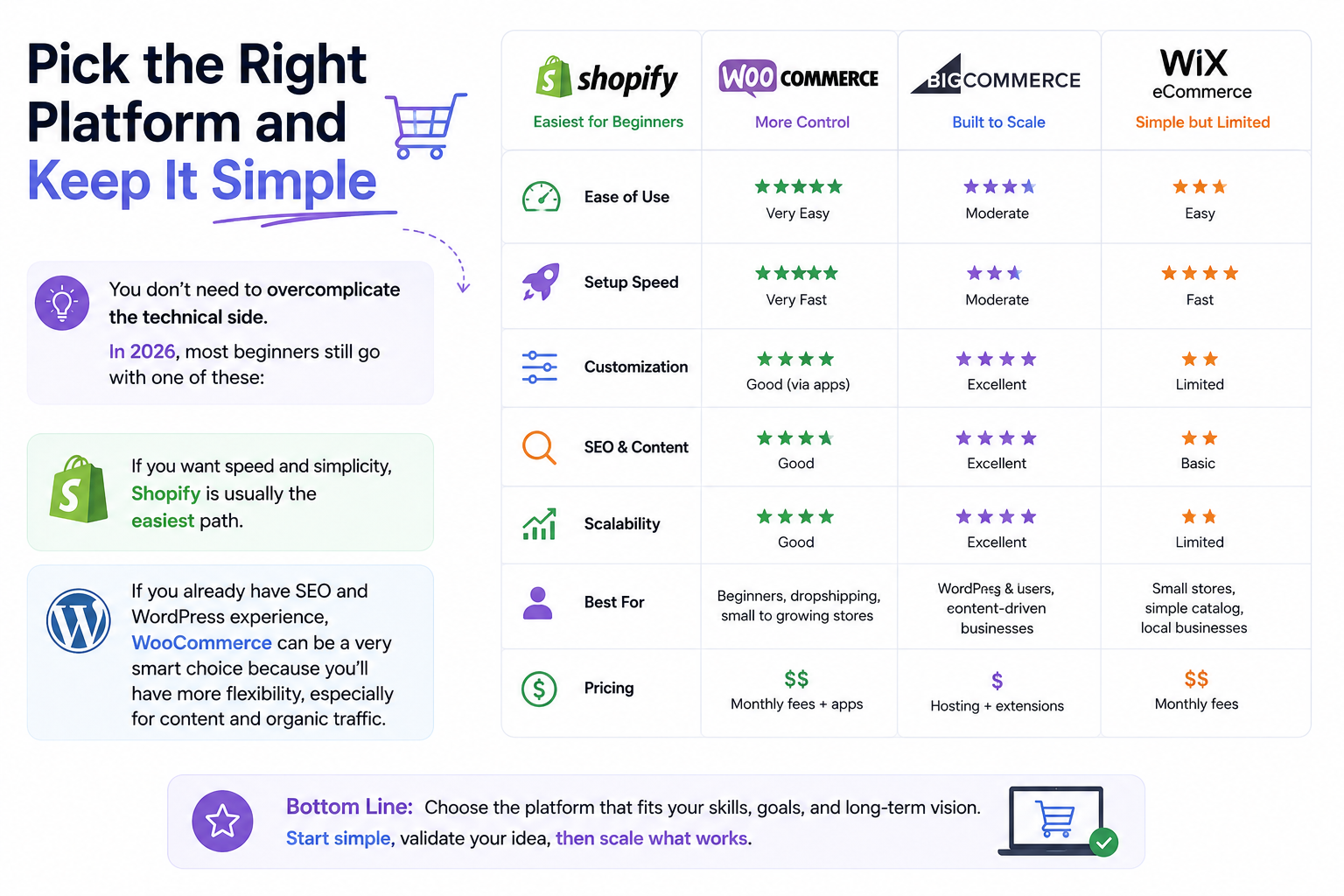
You don’t need to overcomplicate the technical side.
In 2026, most beginners still go with one of these:
- Shopify – easiest for beginners, fast to launch, good app ecosystem
- WooCommerce – best if you want more control and you already understand WordPress
- BigCommerce – useful for scaling, but less beginner-friendly
- Wix eCommerce – okay for simple stores, but not my first choice for long-term growth
If you want speed and simplicity, Shopify is usually the easiest path. If you already have SEO and WordPress experience, WooCommerce can be a very smart choice because you’ll have more flexibility, especially for content and organic traffic.
Whatever platform you choose, your store should have these basics:
- mobile-friendly design
- fast loading pages
- simple navigation
- easy checkout
- trust badges or security signals
- clear shipping information
- clear return/refund policy
- real contact details
A lot of stores lose sales not because the product is bad, but because the buying process feels uncertain.
Payments, shipping, and trust can make or break conversions
This is the part people usually ignore until customers start complaining.
You need to think about how people will pay and how they’ll receive the product before you launch.
Depending on your market, common options include:
- card payments
- Stripe
- PayPal
- local payment gateways break conversions
- Cash on Delivery (especially useful in some regions)
Then there’s shipping.
In 2026, customers don’t just care about price. They care about expectations. If shipping takes 12 days, say it clearly. If returns are allowed, explain how. If you offer free shipping above a certain amount, make that visible.
Clarity builds trust.
At minimum, your store should include:
- Privacy Policy
- Terms & Conditions
- Shipping Policy
- Refund / Return Policy
- Contact Page
These pages are not just formalities. They help your store feel legitimate, especially for first-time visitors.
If you ignore SEO, you’re leaving long-term money on the table
Since you already work in SEO, this is where you can have a huge edge over a lot of eCommerce beginners.
Many new sellers depend completely on paid ads. That can work, but it also makes the business fragile. If ad costs go up or campaigns stop performing, sales can disappear fast.
SEO gives you another path.
For eCommerce in 2026, strong SEO starts with the basics:
- keyword-focused category pages
- unique product descriptions
- optimized product titles
- internal links between products, collections, and blog posts
- clean site architecture
- schema markup
- compressed images
- fast page speed
- mobile usability
But don’t stop there.
If you want organic traffic that actually converts, create blog content around buying intent and pre-purchase questions.
For example, if your store sells kitchen organizers, useful blog topics could be:
- best kitchen storage ideas for small apartments
- how to organize deep kitchen drawers
- must-have products for a clutter-free kitchen
This kind of content helps bring in users earlier, before they’re ready to buy. And if your internal linking is strong, those readers can naturally move into product pages.
That’s how eCommerce SEO compounds over time.
Social media is not optional anymore
You don’t need to become a full-time content creator, but in 2026, social proof and short-form visibility matter a lot.
People discover products while scrolling. Sometimes they don’t even go looking for them.
That’s why simple content can outperform expensive ad creatives.
Focus on things like:
- product demos
- quick problem-solution clips
- unboxing style videos
- before-and-after results
- customer reactions
- user-generated style content
- behind-the-scenes clips
The best part? This kind of content doesn’t need to look overproduced. In many cases, content that feels casual and real actually performs better because it looks more believable.
Launch faster than you think, then improve with data
A lot of beginners wait too long.
They keep editing the homepage, changing the logo, testing colors, rewriting the “About Us” page 10 times… and never really launch.
That’s a trap.
Your first goal is not perfection. Your first goal is to get real feedback from real visitors.
Once you launch, pay attention to:
- which products get clicks
- which pages have high bounce rates
- where people abandon checkout
- what questions customers keep asking
- which traffic source converts best
- what product gets added to cart but not purchased
That information is gold.
It tells you what to improve instead of forcing you to guess.
Final thoughts
Starting an eCommerce business in 2026 is still one of the best online business opportunities out there, but only if you treat it like a business and not a shortcut.
You do not need a huge budget.
You do not need a massive product catalog.
And you definitely do not need to wait until everything is “perfect.”
What you do need is:
- a focused niche
- a product people actually want
- a store that looks trustworthy
- clear shipping and payment setup
- a real branding angle
- consistent traffic strategy through SEO, social, or both
If you build it with patience and test based on real data, eCommerce can absolutely work in 2026.
The people winning now are not always the ones with the biggest budget. They’re usually the ones who understand the customer better than everyone else.