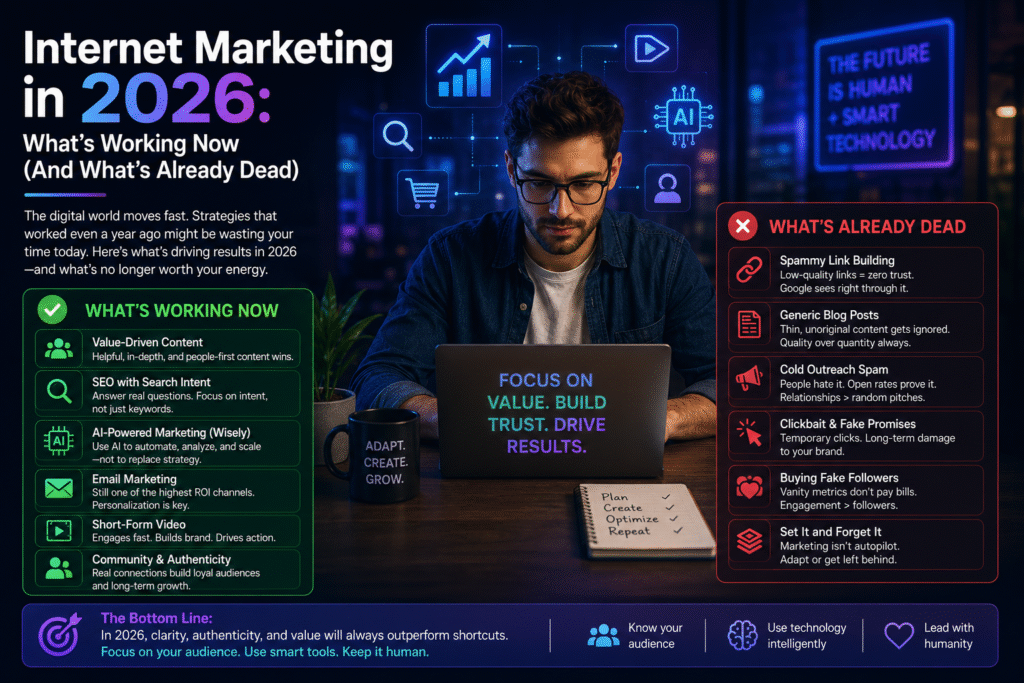

A few years ago, internet marketing felt a lot simpler.
Not easier, exactly but simpler.
You could publish a decent blog post, run some Facebook ads, throw a few keywords into your service pages, stay active on social media, and usually get some kind of result. It wasn’t perfect, but the rules were more predictable.
That’s not really the case anymore.
In 2026, internet marketing is still full of opportunity, but it’s also full of noise. More businesses are online. More content is being published every day. More ads are competing for the same attention. And now that AI tools can generate content, emails, captions, ad copy, and even whole campaigns in minutes, the internet has become crowded in a completely different way.
That’s the real shift.
It’s not that marketing stopped working.
So if you’re trying to understand where internet marketing actually stands right now, here’s the honest answer:
Some things are still working extremely well.
Some things are barely hanging on.
And some strategies are already dead even if people are still teaching them.
What’s Actually Working in Internet Marketing in 2026
Let’s start with the good news.
Because despite all the changes, internet marketing is still very powerful. It just rewards a different kind of marketer now.
1. SEO that matches intent, not just keywords
SEO is still alive. Very much alive.
But the old version of SEO, the one where people obsess over exact-match keywords, stuff them into headings, and think that alone will win rankings, that version is fading fast.
In 2026, search engines are much better at understanding what the user actually wants, not just what they typed.
That means if someone searches for something like “best CRM for small service business,” they’re not looking for a page that repeats that phrase 19 times. They want comparisons, honest pros and cons, maybe pricing context, maybe who it’s not for. They want a useful answer.
That’s why content built around search intent is outperforming content built around keyword formulas.
The pages doing well right now usually have:
- clear topical depth
- better internal linking
- original insight
- real examples
- stronger E-E-A-T signals
- a more helpful structure overall
In simple words: if your SEO strategy still looks like it belongs in 2021, you’re already behind.
2. AI-assisted content… but not AI-written content
This one matters a lot.
Yes, AI is everywhere in 2026. Every marketer knows that by now.
But here’s the funny part: because everyone is using AI, pure AI content is becoming easier to spot not always by software, but by people.
You can feel it when you read it.
It sounds polished, but empty. Clean, but forgettable. Technically fine, but somehow it says nothing new.
That’s why the content performing best right now usually follows a better model:
AI helps with speed. Humans add the edge.
Smart marketers are using AI for:
- research support like can robots are replac humans
- outlines
- angle generation
- repurposing
- content planning
- first drafts
But the final version still needs a human hand.
It needs:
- opinions
- real examples
- sharper phrasing
- stronger positioning
- natural voice
- a point of view
If you publish exactly what AI gives you, you’ll probably blend into the pile.
And in 2026, blending in is expensive.
3. Short-form video that teaches, not just entertains
Short-form video is still huge, but the game has changed a bit.
A while back, brands were chasing trends just to stay visible. Random hooks, trend audios, forced edits, low-context clips a lot of that still exists, but it doesn’t always translate into real business value.
What’s working better now is simple:
quick videos that actually teach something useful.
That could be:
- one mistake your audience is making
- one myth in your industry
- one practical tip
- one short breakdown
- one “before you do this, know this” style insight
These kinds of videos work because they respect attention.
People don’t want fluff. They want something they can understand fast and remember later.
In 2026, the best short-form content is often not flashy at all. It’s just clear, useful, and delivered with confidence.
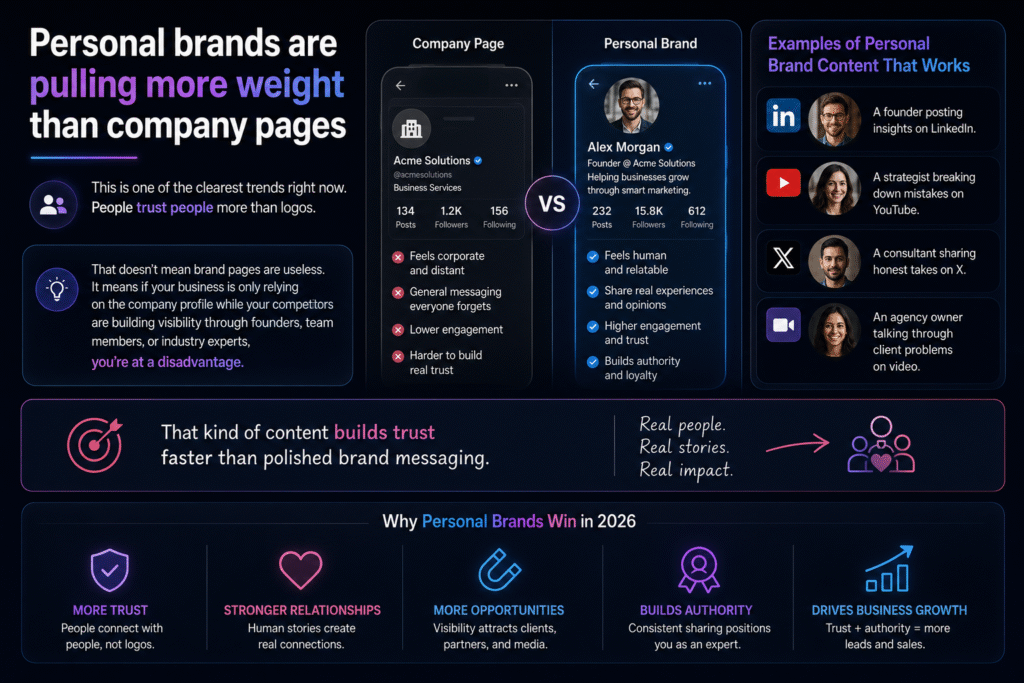
4. Personal brands are pulling more weight than company pages
This is one of the clearest trends right now.
People trust people more than logos.
That doesn’t mean brand pages are useless. It means if your business is only relying on the company profile while your competitors are building visibility through founders, team members, or industry experts, you’re at a disadvantage.
A founder posting insights on LinkedIn.
A strategist breaking down mistakes on YouTube.
A consultant sharing honest takes on X.
An agency owner talking through client problems on video.
That kind of content builds trust faster than polished brand messaging.
Why? Because it feels real.
In 2026, people want to know:
- who is behind the business
- whether they actually know their stuff
- whether their advice sounds experienced
- whether they can trust them before booking a call
That’s why personal brand-led marketing is no longer a bonus. In many industries, it’s becoming a growth channel by itself.
5. Email is still strong… if it doesn’t feel like marketing
A lot of people keep predicting the death of email marketing.
Still hasn’t happened.
What has died is bad email marketing.
The generic kind.
The kind where every subscriber gets the same message, the same pitch, the same lifeless template, and the same “limited time offer” tone.
That approach is tiring.
What still works in 2026 is email that feels relevant and human.
That means:
- better segmentation
- simpler copy
- emails based on behavior
- educational sequences
- plain-text style messages
- follow-ups that don’t sound automated even when they are
The best marketing emails now often read like a real person wrote them quickly, not like a brand spent 3 hours designing a campaign nobody wants to read.
And that’s exactly why they work.
6. Landing pages that are built to convert, not just look nice
This is where a lot of businesses still lose money. They focus hard on traffic SEO, ads, social, content but once people land on the page, the experience falls apart.
Weak headline.
(I want you to structure this article without adding or removing any Word)
Generic copy.
No trust signals.
No clear next step.
Too much clutter.
Bad mobile experience.
In 2026, good internet marketing is tied directly to conversion quality.
It’s not enough to get the click.
You have to make the next step feel obvious.
The best-performing pages usually do a few simple things well:
- they say exactly what the offer is
- they explain who it’s for
- they show proof
- they remove confusion
- they make the CTA easy to understand
This sounds basic, but most websites still get it wrong.
What’s Dying (Or Already Dead)
Now for the part a lot of marketers don’t like hearing.
Because yes, some strategies are still being sold, repeated, and taught
even though they’re clearly losing power.
1. Mass-produced AI blog spam
This is probably the biggest one.
Publishing 50 generic AI articles a month just because you can is not a real content strategy.
It might look productive in a spreadsheet.
It might even create temporary traffic in some cases.
But long term? It usually creates a weak brand footprint.
Why?
Because most of that content:
- sounds similar
- lacks depth
- has no original thought
- doesn’t build trust
- adds very little that already isn’t online
There’s too much of it now.
And because there’s too much of it, the value drops.
In 2026, more content is not automatically better marketing.
That idea is dying fast.
2. Keyword stuffing and checkbox SEO
This needed to die a long time ago.
If a page still feels like it was written for a search engine instead of a human being, it usually shows.
Awkward headings.
Forced keyword repetition.
Over-optimized copy.
Thin FAQ sections added just to “target more queries.”
That stuff is not the edge anymore.
Search engines have matured.
Users have too.
If your page feels unnatural, it usually underperforms eventually even if it gets lucky for a while.
3. Vanity metrics obsession
A post got 50,000 impressions.
Cool.
Did it bring anything useful?
A reel got thousands of views.
Nice.
Did it attract the right audience?
A blog got traffic.
Okay.
Did it generate leads, trust, or sales conversations?
In 2026, smart marketers are getting more serious about what actually matters.
That means focusing more on:
- qualified traffic
- conversion rate
- lead quality
- pipeline contribution
- retention
- revenue influence
Vanity metrics still have context.
But if they’re the main scoreboard, they can mislead you badly.
4. Copy-paste content across every platform
Repurposing is smart.
Copy-pasting is lazy.
There’s a difference.
A LinkedIn post should not always look like an Instagram caption.
A Twitter/X thread shouldn’t read like a blog intro.
A YouTube Short hook won’t always work on Facebook.
In 2026, platforms have become more behavior-specific. Audiences notice when content was clearly dumped everywhere without thought.
The marketers getting better results are adapting the same idea for different platforms, not duplicating the same exact post word for word.
That extra effort matters more now.
5. Overly polished, corporate-sounding brand language
This is another big one.
A lot of businesses still sound like they’re trying to impress instead of communicate.
In 2026, people are even less patient with vague brand fluff than they used to be.
Clear beats fancy.
Specific beats are polished.
Honest beats “professional-sounding.”
The brands getting attention right now usually sound more direct, more confident, and more grounded in reality.
So What’s the Real Play in 2026?
If you strip away all the hype, internet marketing in 2026 is not really about finding some magical new trick.
It’s more about doing a few important things better than everyone who’s cutting corners.
Right now, the businesses getting real results are usually the ones doing this:
- creating content that actually says something useful
- using AI without sounding like AI
- building trust before trying to sell
- improving conversion paths, not just traffic sources
- showing real people behind the brand
- focusing on message clarity
- understanding platform behavior instead of forcing the same tactic everywhere
That’s it.
No mystery.
No hidden thing
Final Thoughts
Even in 2026, internet marketing remains one of the most effective ways for businesses to grow online.But it’s less forgiving now.The gap between smart marketing and lazy marketing is wider than it used to be.If your strategy still depends on generic AI content, shallow SEO, weak landing pages, and surface-level social activity, you’ll probably feel like “marketing doesn’t work anymore.” It does work.It just doesn’t reward shortcuts the same way it used to.And honestly, that’s probably a good thing.Because in a crowded internet, the brands that win now are usually the ones that feel more useful, more credible, and more human.That’s the real direction of internet marketing in 2026.And the sooner businesses accept that, the better their results will be.