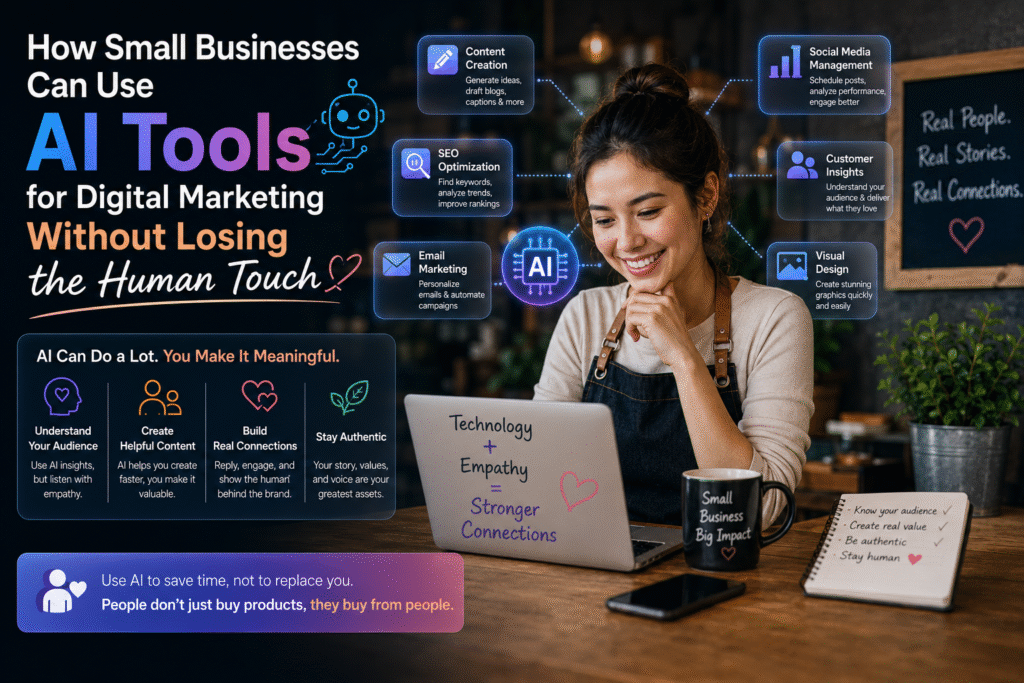

AI is everywhere now. A year or two ago, a lot of small business owners were still treating it like a trend. Something interesting. Something to “look into later.”
That phase is over.
In 2026, AI is already part of how digital marketing gets done. It helps with writing content, planning campaigns, replying faster, spotting patterns in data, improving ad performance, and saving time on repetitive work. For a small business, that sounds like a win and honestly, in many cases, it is.
The more businesses start using AI, the easier it becomes for brands to sound the same. And for small businesses, that’s dangerous. Because small businesses usually don’t win by being the loudest or spending the most. They win because they feel personal. They feel real. People trust them faster. There’s usually a face behind the business, a story behind the service, and a personality behind the brand. That’s exactly what shouldn’t get lost.
So the real question isn’t whether small businesses should use AI in digital marketing.
They should.
The better question is this:
How do you use AI without making your brand sound like a machine?
That’s where smart businesses are separating themselves right now.
AI Can Help a Lot But It Shouldn’t Replace Your Voice
A lot of business owners make the same mistake in the beginning. They discover a few AI tools, see how fast they can generate content, and suddenly everything starts going through AI.
Instagram captions.
Blog posts.
Product descriptions.
Ad copy.
Website content.
Even replies to customer comments sometimes. Like robots are replacing nurses in advance hospitals.
At first, it feels efficient. And it is. You save time. You stop staring at blank pages. You get momentum.
But after a while, something starts feeling off.
The content is technically “fine,” but it doesn’t feel like you anymore.
It sounds clean, but generic.
Professional, but forgettable.
Grammatically correct, but emotionally flat.
That’s the part many small businesses miss.
AI can produce words quickly. What it usually can’t do on its own is capture the little things that make your business relatable: the tone you naturally use with customers, the way your audience actually speaks, the frustrations they repeat in real conversations, the little jokes, the cultural context, the lived experience behind your advice.
That stuff matters.
Especially now.
People are seeing more AI-generated content every single day. Most of it blends together. It says the right things, but it doesn’t say them in a way that feels memorable.
And if your brand starts sounding like that too, you lose the one advantage small businesses often have over larger companies:
real human connection.
The businesses getting the most value from AI are not the ones handing over their entire marketing process.
Think of AI as support.
Not a replacement.
That means it’s excellent for helping with the parts of marketing that are repetitive, time-consuming, or mentally draining.
For example, AI can help you brainstorm content ideas when you’ve run out of steam. It can organize blog topics into clusters. It can suggest five headline angles for an ad campaign. It can summarize customer reviews and tell you what people keep complaining about. It can help draft an email when you already know what you want to say but don’t want to start from scratch.
That’s where it shines.
It removes friction.
It helps small teams move faster.
It gives you a starting point.
But the final layer the part people actually connect with still needs a human touch.
That’s the part where you ask:
Would my customers recognize my tone in this?
Is this specific enough to feel believable?
Does this reflect real experience, or just polished filler?
If the answer is no, it needs editing.
And usually, that editing is where the real marketing happens.
Small Businesses Have Something AI Doesn’t: Closeness
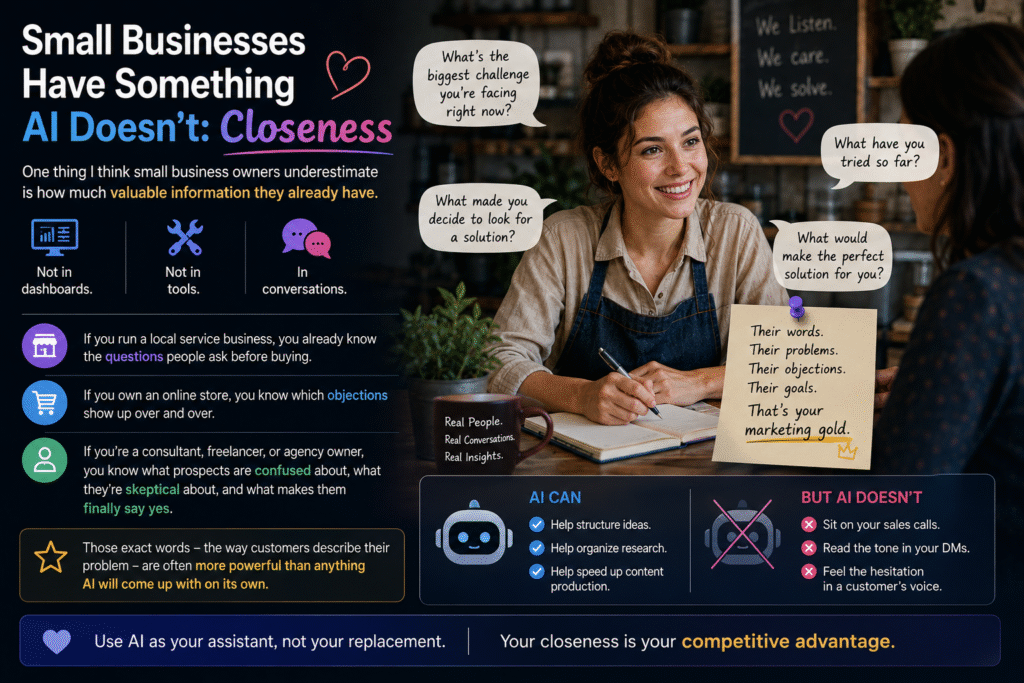
One thing I think small business owners underestimate is how much valuable information they already have.
Not in dashboards.
Not in tools.
In conversations.
If you run a local service business, you already know the questions people ask before buying.
If you own an online store, you know which objections show up over and over.
If you’re a consultant, freelancer, or agency owner, you know what prospects are confused about, what they’re skeptical about, and what makes them finally say yes.
That is marketing gold.
Because those exact words the way customers describe their problem are often more powerful than anything AI will come up with on its own.
AI can help structure ideas.
It can help organize research.
It can even help speed up content production.
But it doesn’t sit on your sales calls.
It doesn’t read the tone in your DMs.
It doesn’t hear the hesitation in a customer’s voice when they ask, “What if this doesn’t work for me?”
You do.
That closeness is an advantage.
And the best small businesses use AI around that human insight, not instead of it.
Where AI Makes the Most Sense in Digital Marketing
If you use it strategically, AI can genuinely make small business marketing easier without making it feel fake.
For content marketing, it can help with outlines, topic ideas, repurposing blog posts into social content, and finding FAQ-style questions people care about. That’s useful. It speeds things up. But if you’re publishing long-form content, especially on your website, the best-performing pieces usually still need your own perspective, examples, and opinions.
In SEO, AI can be a huge time-saver. It can help with keyword grouping, search intent analysis, content brief creation, internal linking suggestions, and semantic topic mapping. For someone like you, especially with your SEO background, you already know the difference between “optimized content” and “content that actually converts.” AI can help build structure, but trust and conversion still come from real insight, not just coverage.
In email marketing, AI can generate subject line options, draft campaign flows, and even suggest segmentation ideas. But the emails people remember are usually the ones that feel like they came from a person, not a system.
In social media, AI can help you stay consistent. It can generate hooks, reword captions, or give you content pillars for the month. But the posts that actually create engagement usually include a real opinion, a real lesson, a small story, or something that feels emotionally honest.
That’s the pattern across every channel.
AI can improve output.
Humans create resonance.
The Risk Isn’t Using AI It’s Sounding Like Everyone Else
A lot of brands are going to have a content problem this year.
Not because they’re not posting enough.
Because they’re posting too much of the same type of content.
Same hooks.
Same “value-packed” carousels.
Same motivational tone.
Same recycled advice.
Same overused phrases.
Same fake confidence.
You’ve probably seen it already.
Everything starts to feel polished, but empty.
That’s what happens when AI becomes the writer instead of the assistant.
And the truth is, customers can feel it.
They may not say, “This sounds AI-generated.”
But they do scroll past it.
They do ignore it.
They do forget it.
That’s what matters.
For a small business, forgettable content is expensive. You don’t have endless reach to waste. Every piece of content should either build trust, create familiarity, answer a real question, or move someone one step closer to action.
If AI makes your content easier to produce but harder to believe, it’s being used the wrong way.
The Human Touch Is Not Just Branding It Affects Results
Sometimes people talk about “human touch” like it’s just a nice brand value. Like AI is changing modern healthcare.
It’s not.
It affects performance.
People respond to specificity.
They trust details.
They remember stories.
They connect with tone.
They buy when something feels real.
A bland post with perfect grammar won’t outperform a post that sounds like it came from actual experience.
A generic blog won’t beat one that includes clear examples, strong opinions, and real-world observations.
A polished email won’t always outperform one that feels honest and direct.
This matters even more now because trust has become one of the most valuable assets in digital marketing.
There’s more content than ever.
More automation.
More noise.
Which means being believable matters more than being prolific.
That’s a big opportunity for small businesses.
Because unlike large brands, small businesses can still feel personal at scale if they’re careful.
Use AI to Save Time. Use Your Voice to Build Trust.
If I had to simplify the best approach, it would be this:
Use AI to make the process faster.
Use your own voice to make the message matter.
That’s the balance.
Let AI help with:
Brainstorming
Research
Outlines
Drafting
Summaries
Repetitive tasks
Reporting
Content repurposing
Workflow automation
But keep control over:
Final messaging
Tone of voice
Customer empathy
Storytelling
Strategic positioning
Brand personality
Sensitive communication
Trust-building content
That balance is what separates smart AI use from lazy AI use.
And customers notice the difference.
Final Thoughts
Small businesses absolutely should use AI in digital marketing.
At this point, ignoring it completely would be a mistake.
It can save time, reduce workload, help you stay consistent, and give small teams the kind of leverage they didn’t have a few years ago.
But it should never come at the cost of what makes your brand feel human.
Because in a market full of automated content, human brands stand out more not less.
The businesses that will do well in 2026 won’t be the ones using the most AI tools.
They’ll be the ones using them with restraint.
They’ll let AI handle repetitive work.
They’ll use it to speed up research.
They’ll use it to create structure and momentum.
But when it’s time to build trust, share a perspective, tell a story, answer a concern, or connect with a customer they’ll sound like a real person.
And honestly, that’s what people still want.
Not perfect content.
Not robotic efficiency.
Not another “optimized” brand voice.
Just something real enough to trust.